





Mechanical Engineering Group
| MECHANICAL ENGINEERING GROUP | Anjan Dutta Gupta | |
| Cryogenic Plants and Instrumentation Division | Sandip Pal | |
| Cryogenic Instrumentation Section | Tamal Kumar Bhattacharyya | |
| Accelerator Technology Development (Mech.) Division | Chinmay Nandi | |
| Injection & Extraction System | Sumantra Bhattacharya | |
| Advanced Machining & Measurement System | Suvadeep Roy | |
| Mechanical Engineering Division | Bidhan Chandra Mandal | |
| Fire Safety Section | Bidhan Chandra Mandal | |
| Fire Safety Cell | Rajkumar Pandit | |
| Transport Maintenance Unit | Bidhan Chandra Mandal | |
| Mechanical Engineering Design & Research Division | Anjan Dutta Gupta | |
| Helium Technology and Low Temperature Section | Jedidiah Pradhan | |
| Mechanical Workshop Section | Pranab Bhattacharyya | |
| Mechanical Maintenance (SCC-RF) Section | Subrata Saha | |
| Safety Cell | Subrata Saha | |
| Low Conductivity Water System | Joydeep Mishra | |
| Engineering Services Division | Anjan Dutta Gupta | |
| Electrical Section | Umashankar Panda | |
| Air Conditioning Section | Md. Waseem Siddiqui | |
| Civil Maintenance Section | Swagato Chakroborty | |
| Civil Engineering Section | Sabyasachi Chatterjee | |
| Parks & Garden | Sabyasachi Chatterjee | |
Mechanical Engineering Group
Overview
The Mechanical Engineering Group at the Variable Energy Cyclotron Centre (VECC), Kolkata, supports the complete life-cycle of accelerator and detector systems, including design, 3D modeling, prototyping, fabrication, testing, installation, commissioning, operation, and maintenance.
Design & Engineering
- • Advanced FEA, CAD, and CAM software are used for the design and manufacturing of accelerator magnets, RF cavities, and related systems operating at both room and cryogenic temperatures.
- • Detailed engineering models and fabrication drawings are developed to support precision manufacturing.
Manufacturing Facilities
- • Equipped with CNC machines, wire-cut EDM, profile EDM, welding equipment, conventional lathes and milling machines, and Coordinate Measuring Machines (CMMs).
- • Capable of producing high-precision components with complex geometries.
Cyclotron Operation & Maintenance
- • Responsible for the round-the-clock operation and maintenance of both the room-temperature and superconducting cyclotrons.
- • Ensures maximum system availability through priority-based maintenance activities.
Utility Systems
- • Manages low-conductivity water and instrumentation air systems for accelerator operations.
- • Uses Reverse Osmosis (RO) and mixed-bed purification technologies to produce high-purity water.
Cryogenic Systems
- • Operates liquid helium plants continuously to maintain superconducting magnets at 4 K.
- • Expertise includes superconducting magnet design, cryogenic systems, instrumentation, and control systems.
Engineering Services
- • Provides comprehensive civil, electrical, HVAC, and transport maintenance services.
- • Supports new accelerator installations, infrastructure upgrades, laboratories, offices, and residential facilities.
Safety & Compliance
- • Promotes a strong industrial and fire safety culture.
- • A dedicated team oversees the implementation and monitoring of safety practices across the Centre.
Compact Medical Cyclotron Project
Objective: Development of an indigenous compact medical cyclotron for the production of short-lived radioisotopes used in nuclear medicine and Positron Emission Tomography (PET).
Scope of Work:
• Design and development of high-precision magnet system
• Development of RF acceleration system and resonant cavities
• Vacuum system design and integration
• Ion source development and beam extraction system
• Design of target stations for radioisotope production
• Control, instrumentation, and safety interlock systems
• Radiation shielding and radiological safety provisions
Major Contributions:
• Establishment of indigenous capability in medical cyclotron technology
• Development of critical accelerator subsystems using in-house expertise
• Advancement of beam dynamics, RF engineering, vacuum technology, and accelerator controls
• Creation of a multidisciplinary platform integrating mechanical, electrical, electronics, and nuclear engineering disciplines for medical cyclotron applications
Key expected Outcomes:
• Successful development and commissioning of 18 MeV medical cyclotron
• Support for production of PET radioisotopes, particularly Fluorine-18 (¹⁸F)
• Strengthening of national infrastructure for nuclear medicine and medical imaging
• Demonstration of technological self-reliance in advanced accelerator systems
• Generation of valuable scientific, engineering, and operational expertise for future accelerator projects
Impact:
Enhanced availability of medical radioisotopes for diagnosis and research, reduced dependence on imported technologies, and contributed to the growth of indigenous accelerator and healthcare technologies.Helium Technology and Low Temperature Activities
Major activities
1. Dilution Refrigerator
Dilution refrigerator is a device that can achieve and maintain continuous refrigeration in the milli-Kelvin temperature range with substantial cooling power. It takes advantage of the unique low-temperature behaviour of the 3He-4He mixtures below about 0.87K producing phase separation between two isotopes. A lighter and rich in3He called concentrate solution floating on top of the 4He rich phase called dilute solution respectively. In order to maintain the finite solubility of 3He in superfluid 4He, the lighter 3He atoms cross the phase boundary over to dilute solution below results in cooling.Recently, we have indigenously designed, developed and tested a dilution refrigerator for producing milli-Kelvin temperature. The base temperature obtained was below 50mK in the mixing chamber.
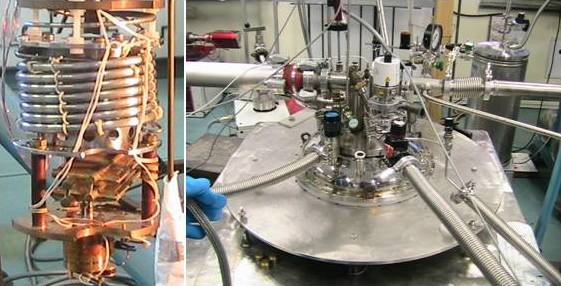
Initially, the project was aimed at developing technologies relevant to dilution refrigerator so each component were designed, fabricated and tested in the laboratory. In this context, we have developed a computer programme SIDFO for initial design and optimization of dilution refrigerator as it greatly reduces the risk of serious design flaws. The infrastructure specific to very low temperature work has been developed for the purpose. Efforts to achieve still lower temperature would be on since low temperatures allow study of quantum phenomena such as superfluid phase transition of 3He, quantum hall effect,semiconductor-based nano-materials, low temperature detectors superconducting tunnel junctions, low temperature nuclear orientation and NMR experiments and so on.
2. Development of Cryogen-free cryostat for Recondensation of helium vapour
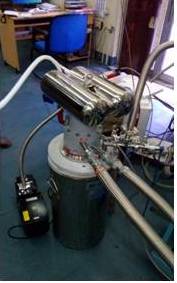
A small scale 4He liquefier has been designed and constructed that is solely based on the cooling of a two-stage 4K pulse tube cryo-cooler. In a further expansion a cryogen-free super-fluid cryostat with closed loop helium circulation system is under development. This cryostat is uniquely qualified to provide the cooling requirement along with an option for magnetic field for materials research, neutron scattering, NMR studies etc. for many branches of physics. Unusual phases of matter such as superconductivity at low temperatures and much subtle behaviour of materials that are obscured by thermal motion at relatively higher temperature can be studied in great detail low temperature regime (~ 1.8 K). The closed cycle super-fluid cryostat will be extremely useful to the experimental nuclear physics community. Some of the very central research areas involve MRI, NMR and SQUIDs. Its usefulness arises from the fact that it operates continuously, it can provide a substantial cooling power along with a magnetic field at temperatures from around 1.8 K and it can run uninterrupted for as long as several months. Most existing superconducting systems employ a liquid helium refilling system that is costly, troublesome and must be maintained by a skilled technician. To replace the standard refill system with helium re-condenser presents a challenge.
Activities
| Article | Author | Journal/Symposium | Year |