






Experimental Nuclear Physics Group
| Experimental Nuclear Physics Group | Sarmistha Bhattacharyya | |
| Experimental Nuclear Physics Division | Kaushik Banerjee | |
| Nuclear Structure Section | Gopal Mukherjee | |
| Nuclear Electronics Section | Jogender Saini | |
| Experimental High Energy Physics Division | Zubayer Ahammed | |
| High Energy Physics Detector Division | Kaushik Banerjee | |
| Cryogenic Trap and Nuclear Spectroscopy Division (Independent) | Parnika Das | |
| Nuclear Lifetime Spectroscopy Section | Tumpa Bhattacharjee | |
Experimental Nuclear Physics
Overview
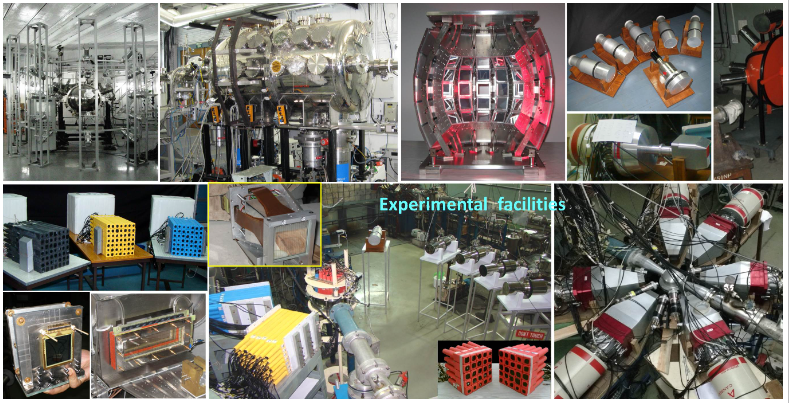
Even after almost one century of its discovery, the atomic nucleus still remains enigmatic! The nucleons in the nucleus are strongly bound, and therefore the nucleus is very reluctant to reveal its secrets so easily. It has to be hammered hard to break into its solid defense – and that is exactly what the experimental nuclear physicists try to do all the time – hit it hard with ‘energetic’ projectiles (light ions like proton, He++ as well as heavy ions like O6,7+, Ne7,8+, etc. ) , detect the observable ‘bruises’ of the collision with innovative ‘detectors’, and interpret the result to find out the secrets of the nucleus.
At VECC, such studies are being carried out for the past three decades using K130 cyclotron. Main research areas covered with K130 cyclotron are: Elastic and inelastic scattering, direct and pre-equilibrium reactions, fusion-fission dynamics, intermediate mass fragment emission, nuclear orbiting/quasi-molecular resonance, gamma-ray spectroscopy and nuclear structure, giant resonance, nuclear Bremsstrahlung, resonance particle spectroscopy, external modification of nuclear decay rate, etc.
We are currently at the doorstep of opening another new and exciting chapter! As soon as the new K500 superconducting cyclotron (typical beam energy ~ 5 – 50 MeV/nucleon or more) is operational, it will open up new and challenging opportunities for carrying out pioneering research in the areas of current interest (i.e., hot nuclei, multi-fragmentation and nuclear liquid-gas phase transition, giant resonances, collectivity and temperature, isospin physics and nuclear equation of state, structure of particle unbound resonances, structure of exotic nuclei etc., to mention a few. Presently, several new, large, state-of-art detector systems and general users’ facilities such as Segmented Horizontal Axis Reaction Chamber (SHARC), 4-pi charged particle detector array, Large Area Modular BaF2 Detector Array (LAMBDA), 4-pi neutron multiplicity detector, neutron time-of-flight detector array, ion trap, etc are being developed (some of them are already commissioned, others are nearing completion) by VECC under the aegis of superconducting cyclotron utilisation project. In the next phase, these detector systems will be augmented with the addition of new features.
Collaborations
Indian National Gamma Array (INGA) Collaboration :
Indian National Gamma Array (INGA) is an array of state of art new generation Compton suppressed Clover HPGe detectors, which is a collaborative national project in India for nuclear structure studies using high resolution gamma ray spectroscopy. Variable Energy Cyclotron Centre has taken one of the leading roles in implementing this project among three accelerator centres in India. INGA project is collaboration among the national institutes, viz., Variable Energy Cyclotron Centre (VECC), Kolkata, Tata Institute if Fundamental Research (TIFR), Mumbai, Inter University Accelerator Centre (IUAC), New Delhi, Saha Institute of Nuclear Physics (SINP), Kolkata, UGC-DAE-CSR, Kolkata Centre and other universities.
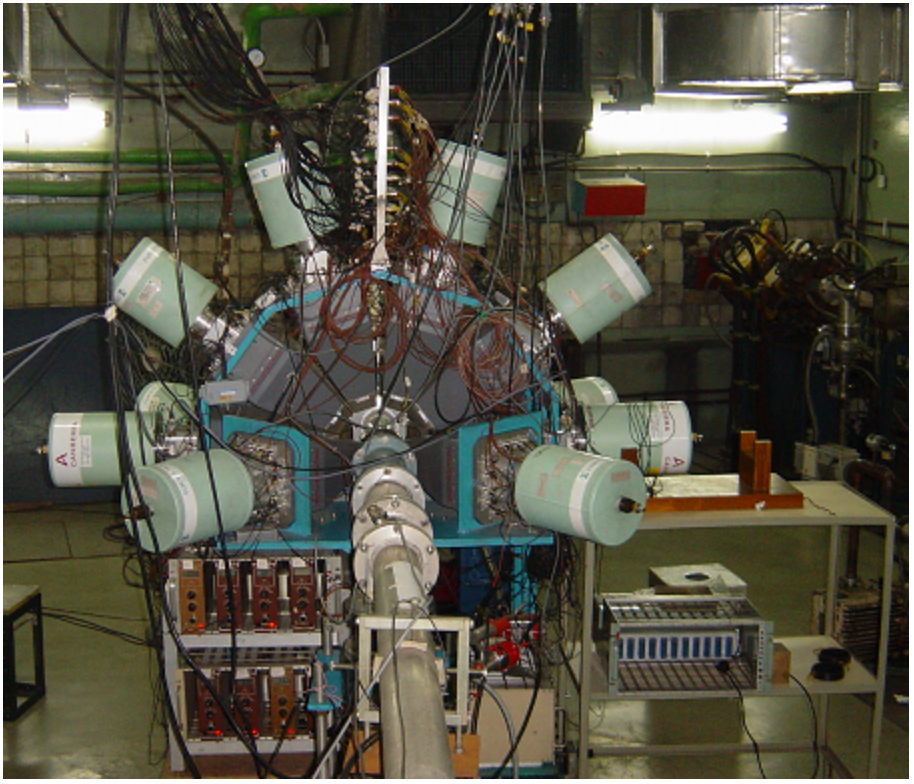
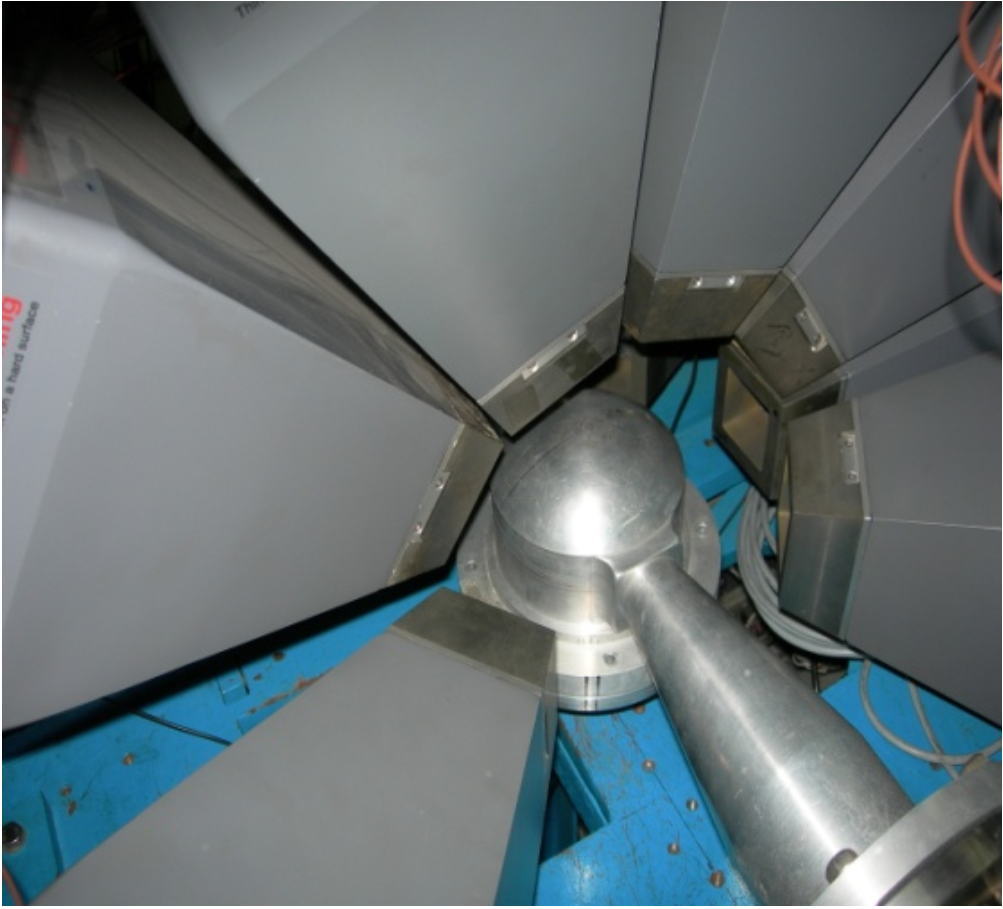
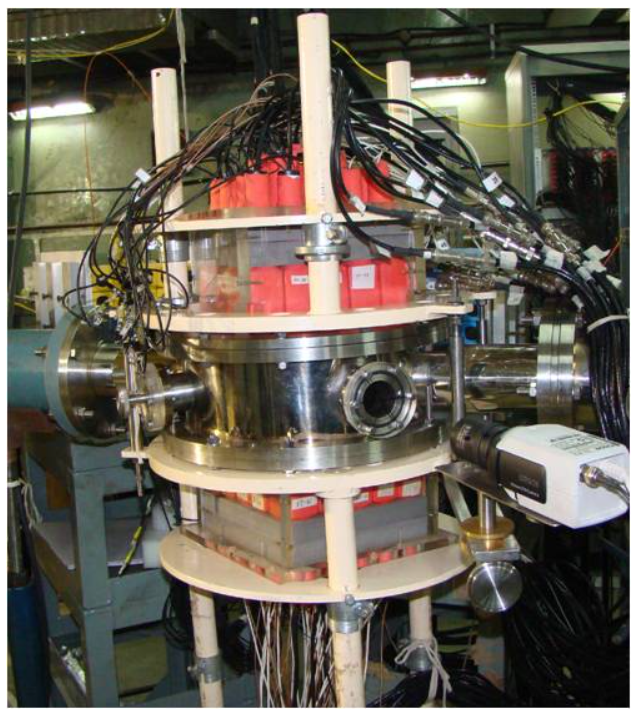
At VECC, Kolkata, the first campaign of INGA took place in 2005 with 10 Compton suppressed Clover HPGe detectors, to explore the physics possibilities with beams of heavy ions of higher energy (~7-8 MeV/n). The energy regime of the beams from ECR ion source was unique which allowed population of nuclei at higher angular momentum using non-equilibrated reaction mechanisms. In this campaign, in addition to the Clover detectors, 2 segmented Planer HPGe detectors, called Low Energy Photon Spectrometer (LEPS), were also added to the INGA setup for tagging of X-rays and to maximize the efficiency of detection of low energy gamma rays below 100 keV. The pictures of this setup at the beamline of K-130 cyclotron is shown in the figure.
Research
Change of electron capture nuclear decay rate in different environments
Is it possible to change the decay rate of a radioactive substance by external means such as pressure, temperature, chemical environment etc.? The answer given in the text books is “No”. However the electron capture radioactive decay(meaning the capture of an orbital electron by the nucleus) should be slightly affected by the external environment. The electron capture decays taking place deep inside massive stars are expected to be faster than observed terrestrially. Perhaps such decays taking place deep inside the earth are also faster than we normally see. At VECC, we are studying the change of electron capture decay rate of 7Be, 109In, 110Sn etc. under pressure and in different chemical environments to learn about such effects. We compressed large radioactive atoms such as 109In, 110Sn etc. by implanting them in a small lattice and recently observed about 1% increase of decay rate.
Nuclear Orbiting Reaction
It is well-known that the nuclei fuse to form a compound nucleus, if they collide with sufficient kinetic energy to overcome the Coulomb barrier. However occasionally in some cases, instead of fusing, the two nuclei form a quasi-bound dinuclear system which would preferentially break apart into the entrance channel without ever undergoing complete fusion. It is generally assumed that the thermal equilibrium of the dinuclear orbiting complex is achieved quickly, but still the two nuclei would maintain their identities inhibiting their fusion.
Nuclear orbiting means that the two nuclei instead of fusing have formed a quasi-bound dinuclear system which would preferentially break apart into the entrance channel without ever undergoing complete fusion. It is generally assumed that the thermal equilibrium of the dinuclear orbiting complex is achieved quickly, but still the two nuclei maintain their identities and their complete fusion is inhibited.
In the literature, the words “Nuclear orbiting reaction” had been used for the last 30-35 years to describe different observed anomalies of nuclear reactions (in the projectile energy region 3-8 MeV/A) that could not be explained by standard statistical model calculations. Usually whenever the observed yields of the emitted fragments were found to be higher than those expected from the standard statistical model calculations or the observed width of the mass distribution of the fragments was found to be wider than that expected from the statistical model calculation, the qualitative idea of nuclear orbiting was invoked in one way or the other. On the other hand, the believers of the statistical model (Moretto and others) tried to show that most of these observations can be explained by adjusting the parameters of the statistical model, using more elaborate statistical model codes and by simple extension of the statistical model, without requiring this idea of orbiting. There was also the question regarding the fundamental difference between a highly deformed rotating compound nucleus and an orbiting complex formed in the entrance channel. Of course, in the exit channel, there is no difference between the two, as the final breakup must be from a dinuclear system.
We differentiate between the formations of an orbiting complex and deformed spinning compound nucleus in the entrance channel by observing entrance channel dependence of the emitted fragments when the same composite is formed by two different reactions at the same excitation energy with very similar spin distributions. At the same time, we also ensure that the reaction mechanism is not a simple direct reaction by observing 1/sinqc.m angular distribution at the back-angles, which should mean the formation of a long-lived intermediate complex. If we find entrance channel dependence (preferential breakup into the entrance channel), in addition to 1/sinqc.m angular distribution at the back-angles, then we consider the formation of an orbiting complex in the entrance channel. Otherwise it should be a compound nucleus in the entrance channel. Using these criteria, it has been found that only a few systems such as 24Mg+16O, 28Si+12C, 16O+89Y, 16O+93Nb (at projectile bombarding energy 4-8 MeV/A) form orbiting complexes at high orbital angular momenta (near the critical angular monetum) and preferentially break apart into the entrance channel. Although a theoretical understanding of the process is still lacking, we are experimentally studying the temperature and the decay process of the orbiting complexes and highly deformed spinning compound nuclei.
Fragments emission studies in light Heavy-ion collision
Study of fragment emission mechanisms for light heavy-ion (Aproj.+ Atarget < 60) collisions, at energies (<10 MeV /u ) is subject of great interest in the recent years. The origin of these fragments extends from quasi-elastic, deep-inelastic transfer and orbiting, to fusion–fission processes; and in some cases the structure of the nuclei has been found to play an important role. Many interesting features, e.g., quasi molecular resonance, super deformed bands, orbiting etc. have been seen for nuclear reactions involving alpha like nuclei. Although, there is no apparent link between these phenomena, they are believed to originate from highly deformed configuration of these systems. The occurrence of such highly deformed configurations and their evolution with excitation energy are studied at VECC through charged particle spectroscopy.
Gamma Ray Spectroscopy
Many of the secrets of an atomic nucleus, a tiny object but a potential source of huge energy, can be understood by putting it under “extreme conditions” and studying how it survives such a stress. Gamma ray spectroscopy is one of the powerful tools for such study and to “visualize” the shape and shell structure of a nucleus. The “extreme conditions” of large isospin (neutron-proton asymmetry), high excitation and large angular momentum are achieved in a nucleus by producing them in a variety of direct and indirect nuclear reactions using energetic beam of particles from an accelerator. The gamma rays, emitted from the produced nuclei, carry the information of the shape of a nucleus and the quantum states of the protons and the neutrons inside it. These gamma rays are detected using several high resolution, state-of-the-art, Hyper Pure Germanium (HPGe) Detectors. Several ancillary detectors for detecting charged particles, neutrons and to measure gamma multiplicity are also used in conjunction with the HPGe detectors to achieve better sensitivity. Several such experiments have been performed using the experimental facilities at VECC, at BARC-TIFR Pelletron, Mumbai, Inter University Accelerator Centre, New Delhi and also at various facilities abroad. In these experiments, combined with nuclear model calculations, we try to understand the new symmetries in nuclei (manifested in tetrahedral shape, chiral bands, magnetic rotation etc.), the change in shell structure in extremely neutron rich nuclei, shape change and shape coexistence in nuclei, formation of high spin isomers in nuclei, etc.
Resonance Particle Spectroscopy
Resonance particle spectroscopy is a quite powerful technique in nuclear physics to study the space-time characteristics of particle emission mechanism in nuclear reactions. This is a unique tool to study the structures and properties of the particle-unbound resonance states in nuclei by detecting their decay products in coincidence. One of the major research goals of the charged particle detector array, is to carry out systematic resonance spectroscopy studies of (a) the alpha-cluster structure of light alpha-like nuclei using K130 cyclotron and other accelerators in India, and, (b) the structures of exotic particle-unstable resonances of stable nuclei and nuclei away from alpha-stability line, which will be produced in intermediate energy nuclear reactions using K500 superconducting cyclotron. Recently, studies on 2-alpha structure of 8Be, and 3-alpha structure of Hoyle state of 12C, have been carried out. Hoyle state of 12C is specially interesting as it is claimed to be either a 3-alpha-chain structure or a gas-like condensate. Our new measurements are expected to throw new light on the structures of these resonances.
Study of the Fusion-fission and Quasi-fission Dynamics
We have an active research program to explore the role of entrance channel on fusion-fission dynamics.
One of the major aspects of today’s nuclear physics research is to look for the dynamical effect which inhibits the fusion process. These studies are important since they give a clue for picking up the right kind of target and projectile combination for the formation of super heavy elements (SHE). A comprehensive study of fission fragment mass and angular distribution at near barrier energies was embarked on for heavy ion induced fission reactions experimentally, to have an insight of the dynamics of the fusion-fission reactions. The experiments are carried out with pulsed heavy ions from the accelerators (IUAC Pelletron, New Delhi, BARC-TIFR Pelletron, Mumbai, VECC Cyclotron, Kolkata) available in India using the detectors developed indigenously in the laboratory. For the first time, a direct evidence of orientation dependent quasi-fission reaction was established. A novel and powerful tool to look for the onset of a non-statistical reaction mechanism in heavy ion induced fission was unearthed.
High Energy Photon Spectroscopy
Hot nuclei are formed in heavy ion fusion reaction where the relative kinetic energy of the colliding nuclei is converted into internal excitation energy and high angular momentum of the compound nuclei. These systems are unstable and decay by emission of particles (neutron, proton, alpha-particle, etc.) and heavier fragments. Apart from particle emission, the system can also decay by emitting gamma-rays. The decay of Giant Dipole Resonance (GDR) is one of the way through which the energy is released from the system in the form of electromagnetic radiation (8-20 MeV).
Giant Dipole Resonance: It corresponds to a collective motion involving almost all the particles in the nucleus. It can be viewed as small amplitude, out of phase vibration between the protons and the neutrons. The high-energy decay of GDR built on excited state provides us a unique tool to study the diverse properties of the nucleus at extreme conditions.
>Temperature & angular momentum dependence of the intrinsic GDR width.
> Nuclear shapes at extreme conditions via GDR lineshapes.
> Loss of collectivity, existence of a limiting temperature for collective motion in nuclei.
> Influence of the lifetime of the CN on the observed GDR width.
> Probing the time scale for thermal fluctuations and the validity of “adiabatic picture”.
> Dissipative fission dynamics.
Nucleon – Nucleon Bremsstrahlung: Nuclear bremsstrahlung (> 20 MeV) is released during the first stages of the nuclear reaction in which the nucleus is not equilibrated, allowing one to probe the nucleon-nucleon interaction and the dynamics of nuclear reactions. These high-energy g-rays help in understanding the early states of the nuclear reaction.
> Nuclear medium effects.
> Collision dynamics.
Facilities
Large, Segmented, Horizontal Axis, Reaction Chamber (SHARC) ...
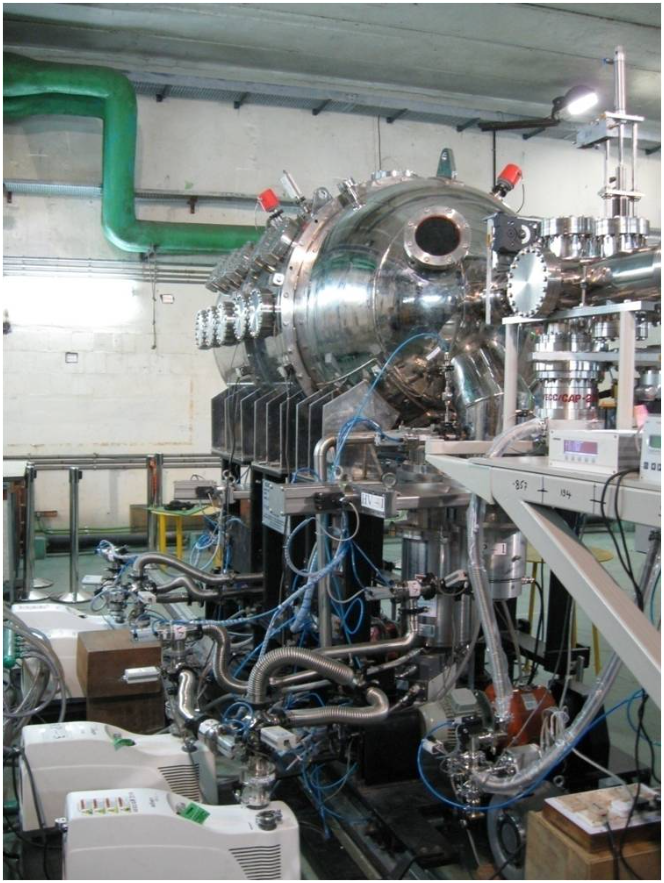
This large, segmented, horizontal axis, reaction chamber (SHARC) is integrated with the beam line in the VECC superconducting cyclotron (SCC) experimental area. It is a cylindrical, three segment, stainless steel chamber of length 2.2 m, diameter 1 m and wall thickness ~10 mm; the front (beam-entry) end is hemispherical in shape having a radius 500 mm and the rear end is elliptical dish (2:1) shaped. Inside SHARC, there are two pairs of parallel rails to put a target ladder and a generalized detector mounting table. The whole target assembly can be placed anywhere on the rail with vertical and rotational movement facility controllable remotely. The generalized detector mounting table has precision alignment mechanism on manually movable stands with a locking arrangement. There is no rotating arm inside; users are encouraged to fabricate their own detector stands as per requirement. The vacuum (in empty chamber) ~1X10⁻⁷ mbar is obtained in 10 hrs by means of two turbo molecular (1000 litre/sec) and two cryo pumps (2500 litre/sec) backed by mechanical pumps.
Large, Segmented, Horizontal Axis, Reaction Chamber (SHARC) ...
Neutron Multiplicity Detector
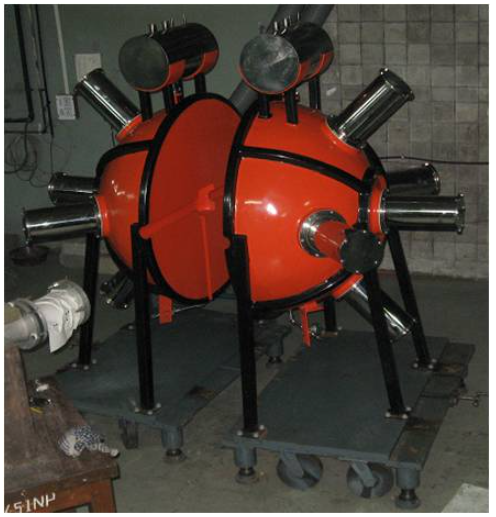
Nutron Multiplicity Detector constitutes a powerful means for the nuclear temperature measurements. It allows to measure, event by event, with high efficiency, the number and total kinetic energy of neutrons emitted in a nuclear reaction. This detector has been developed first time in our country. NMD consists of two stainless steel hemispheres of one metre diameter, filled with 500 litres of 0.5% Gd loaded liquid scintillator BC521. This development involved many sophisticated subsystem developments like, pumping system for liquid scintillator, scintillator testing setup and readout electronic, etc. One of the important characteristics of the above detector is the capture time distribution, which depends on the quantity of the Gd doped in the liquid sctillator.
Neutron Multiplicity Detector
Neutron Detectors for Time of Flight Measurement
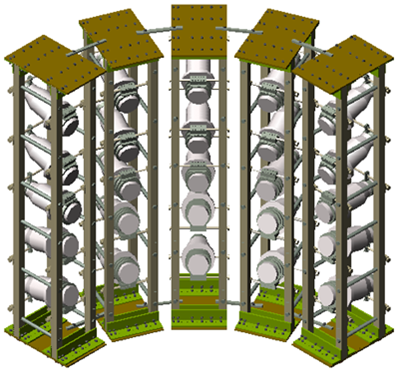
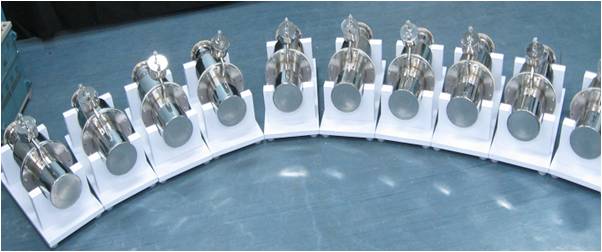
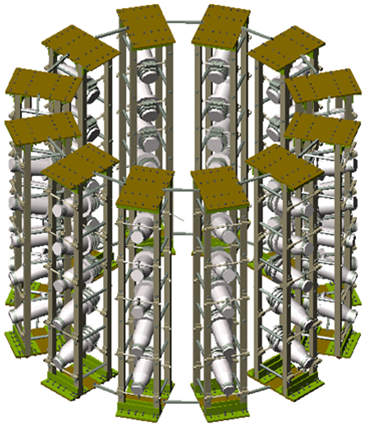
To boost up the experimental nuclear physics research in the country, several detector arrays were planed at VECC under the super conducting cyclotron utilisation project, neutron Time OF Flight (TOF) array is among one of major system. Neutron TOF array has been developed for the precise measurement of neutron energy and angular distribution. The array consists of 50 numbers of neutron detectors, each having 5" diameter and a similar length. Detectors are liquid scintillator based and have been indigenously designed and developed at VECC, after long, involved and careful R & D effort. The primary motivation of the array is to look for answer of the some of today's frontline nuclear physics problems, understand the fission dynamics at near barrier energies, measurement of nuclear level density parameter, multi-fragmentation, exotic fragment studies, etc.
Neutron Detectors for Time of Flight Measurement
Large Area Modular BaF2 Detector Array (LAMBDA)
It is a high energy photon spectrometer, complete with its dedicated front end electronics & data acquisition system.
LAMBDA is the acronym of Large Area Modular BaF2 Detector Array, developed to study the high energy gamma rays, coming from hot composite systems produced during heavy ion collisions. These photons are emitted at very early stages in the evolution or decay process of the hot compound system and can be efficiently used as a tool to study the diverse properties of hot and fast rotating nuclei.
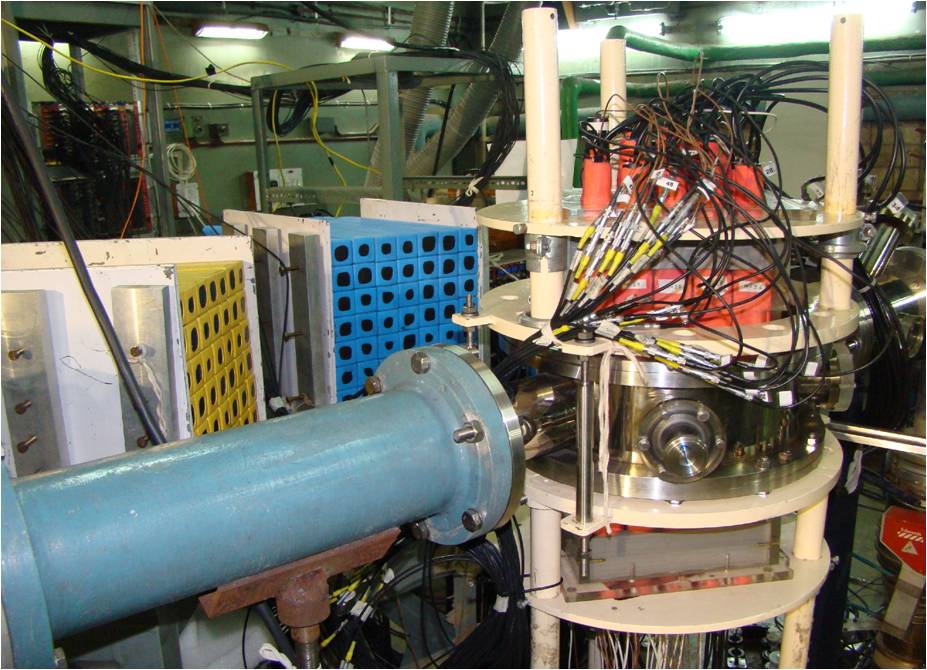
Barium fluoride (BaF2) crystal is a very fast scintillator with a high gamma detection efficiency. Therefore, it is the ideal choice for a high energy photon spectrometer where time-of-flight technique is to be employed for efficient neutron rejection.
Array Features:
* 162 individual detector elements.
* Large gamma detection efficiency.
* Fast timing response (960 ps).
* High Modularity to allow different geometrical configurations depending upon the experimental requirements.
* Dynamic event reconstruction to reject cosmic muons and pile-up events.
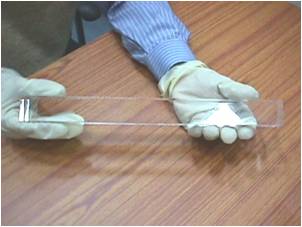
Each crystal has the dimension of 3.5 cm x 3.5 cm cross-sectional area and 35 cm long. The entire spectrometer was fabricated in house from the procured bare crystals.
Electronics & Data Acquisition
A dedicated electronics setup has been developed to register the energy and time information from each detector element in event by event mode. The latest commercially available high-density programmable CAMAC modules were used for its front end dedicated electronics. All electronics & DAQ were kept inside the experimental hall next to the array and were controlled from outside over Ethernet.
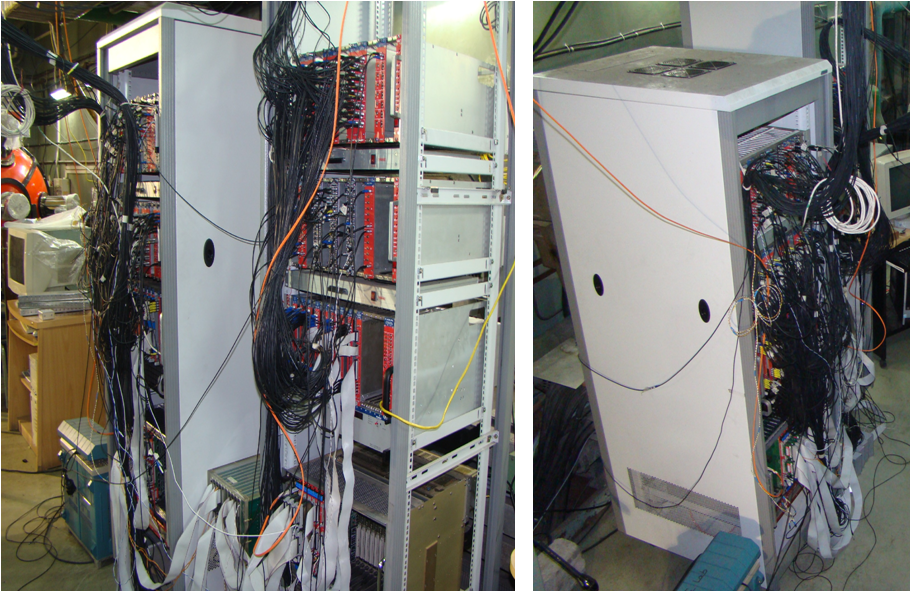
The DAQ associated with the array is based on VME platform in a LINUX environment. High density (32 channels), fast VME QDCs and TDCs have been employed for energy and time measurements. It is capable of handling typically ~4000 events per second without appreciable dead time loss.
Gas detector developement
At VECC, we have an active research program to develop gas detectors for detection of heavy charged particles. After an intensive R and D efforts, few position sensitive Multi-Wire Proportional Counters (MWPC) were designed and fabricated indigenously. These large area detectors (typical area is 20 cm x 6 cm) are proficiently used in experiments at the major accelerator facilities available in our country. The position resolution achieved with these detectors is better than a millimetre and time resolution better than a nanosecond. We have also developed avalanche counters (5 cm x 3 cm active area) that is efficient for ”start time“ measurement in a time of flight setup.
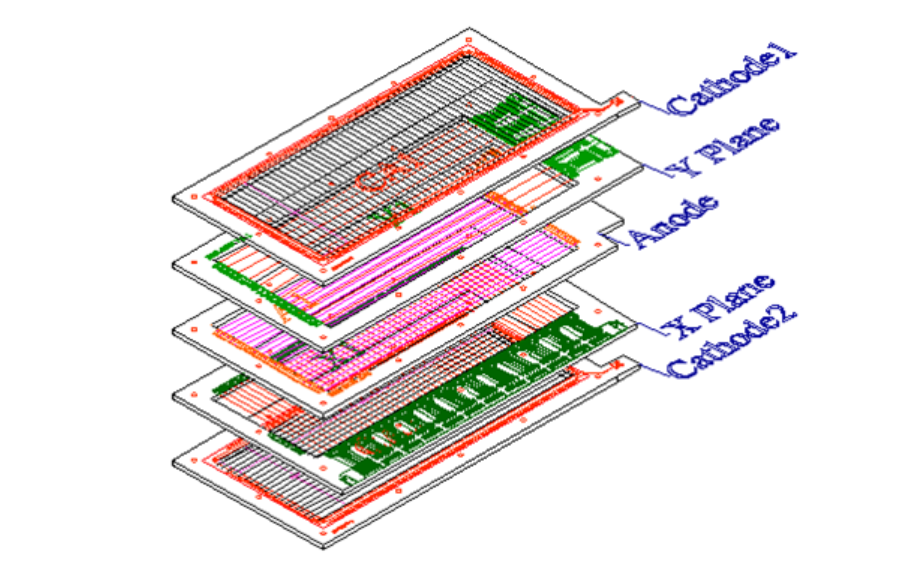
The Breskin type of low pressure multi-wire proportional counters detectors that we have developed consists of 5 wire planes. The central anode wire plane provides the time information. Position information (in both X and Y direction) are achieved by delay line method. Two cathode planes give the energy loss in the detector deposited by the charged particles.
For the assembly, fabrication and testing of gas detectors, we have a well equipped gas detector laboratory. We have developed a film stretching unit for the preparation of thin polypropylene foil used as the entrance window for the detectors. The front-end of the detector is usually covered by a polypropylene film that is required to be thin enough to minimize the energy loss of the detected charged particle. Thick polypropylene sheet (~ 20 micron) available in the market are stretched to less than a micron thickness by this film stretching unit. An aluminium plate, covered by teflon sheet are heated at about 60°C, be in a motion slowly upward by controlled pneumatic action. The plate stretches the polypropylene film mounted on a table.
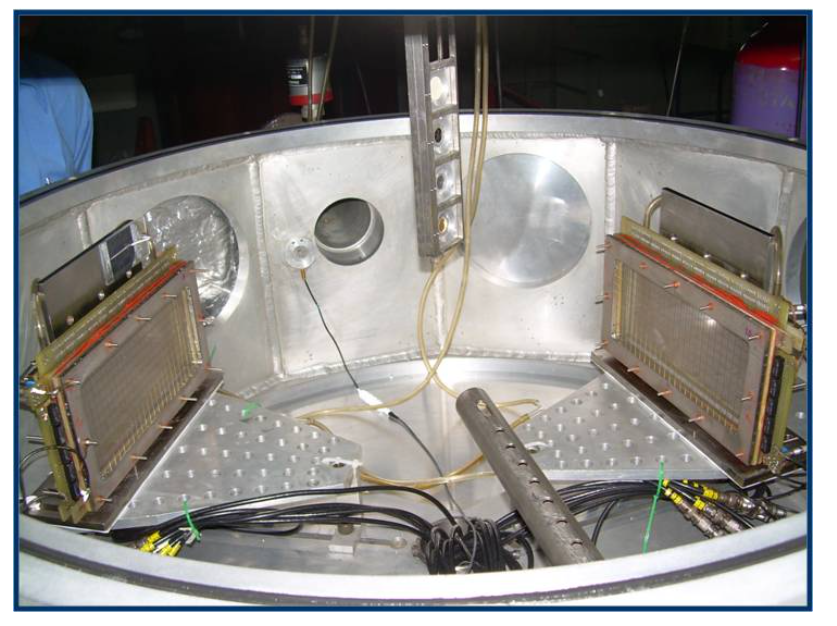
A time of flight setup inside VECC scattering chamber, with the two large area MWPCs developed at our laboratory. In the experiment, masses of the fission fragments were measured from the time of flight difference of the fragments.
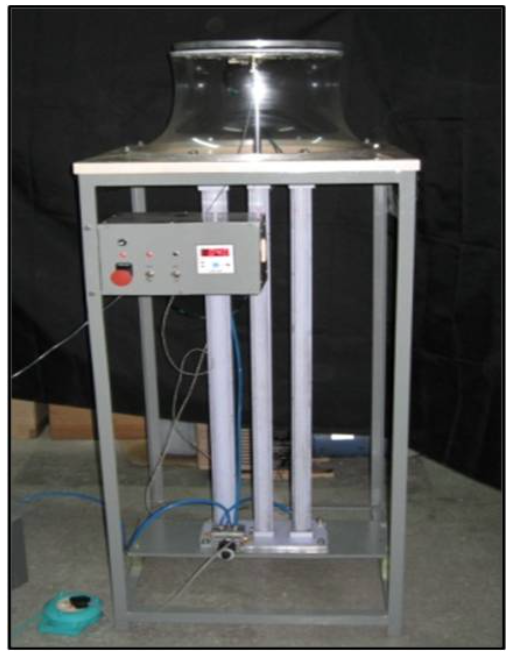
We have also developed our own gas handling system. The detectors are operated in flow mode at a typical pressure of 3 torr of isobutene gas. Since the window of the detector is very thin, it is compulsory that the initial pumping of the detector has to be done very slowly. Any fluctuation of inside gas pressure can tear down the window and thus needs precession flow control. We have designed a gas handling system for this purpose. It consists of a mass flow controller and an electronic valve that protects the window/detector even in case of power failure during experiment. The mass flow controller offers automatic maintenance of the inside gas pressure very accurately.
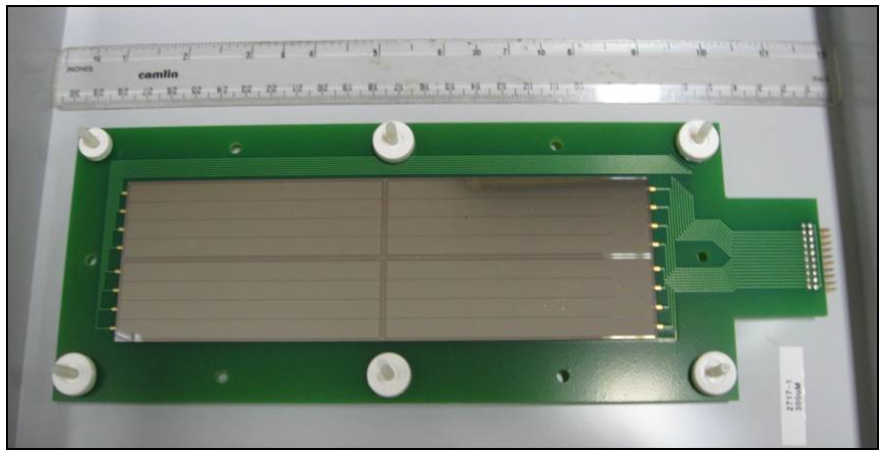
A 16 segment silicon detector which is used as the back side of the hybrid gas detector that provides time, position and energy info of a charged particle.
In our country, in next few years we will have accelerators (Super Conducting Cyclotron at Kolkata, LINACs at Mumbai and Delhi) providing intermediate energy heavy ion beams that may be used for front line research in many challenging areas of nuclear physics. We have a R & D program for the development of detectors for efficient utilization of these accelerator facilities. Fabrication of an unique hybrid detector, conceptually a combination of gas MWPC backed by segmented silicon strips, capable of providing excellent timing, position and energy resolution for heavy fragments is under way.
The MWPCs were used in several experiments to study fusion fission dynamics [e.g; Phys. Rev. C 92, 041601 (R) (2015), Phys. Rev. C 91, 044620 (2015), Phys. Rev. C 83, 024605 (2011), Phys. Rev. C 79, 054607 (2009)].
For more info, you may contact: Tilak Ghosh (tilak@vecc.gov.in) / Chandana Bhattacharya (chandana@vecc.gov.in)
GAMma Multiplicity filter Array (GAMMA)
This array is for the measuring angular momentum of high energy photonevent-by-event.
GAMma Multiplicity filter Array (GAMMA)
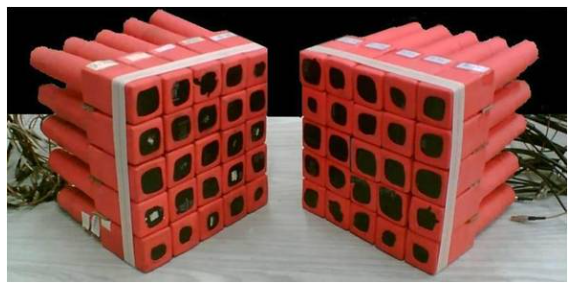
The 50 element BaF2 multiplicity filter, each having dimensions of 3.5 cm x 3.5 cm x 5 cm, is generally used in conjunction with the LAMBDA high energy gamma-spectrometer (or with any other detection systems) for estimating the angular momentum populated in each event. Its fast time response (450 ps) is useful for taking the start trigger (instead of the cyclotron RF) for an improved time-of-flight measurement.
Penning Trap Developement
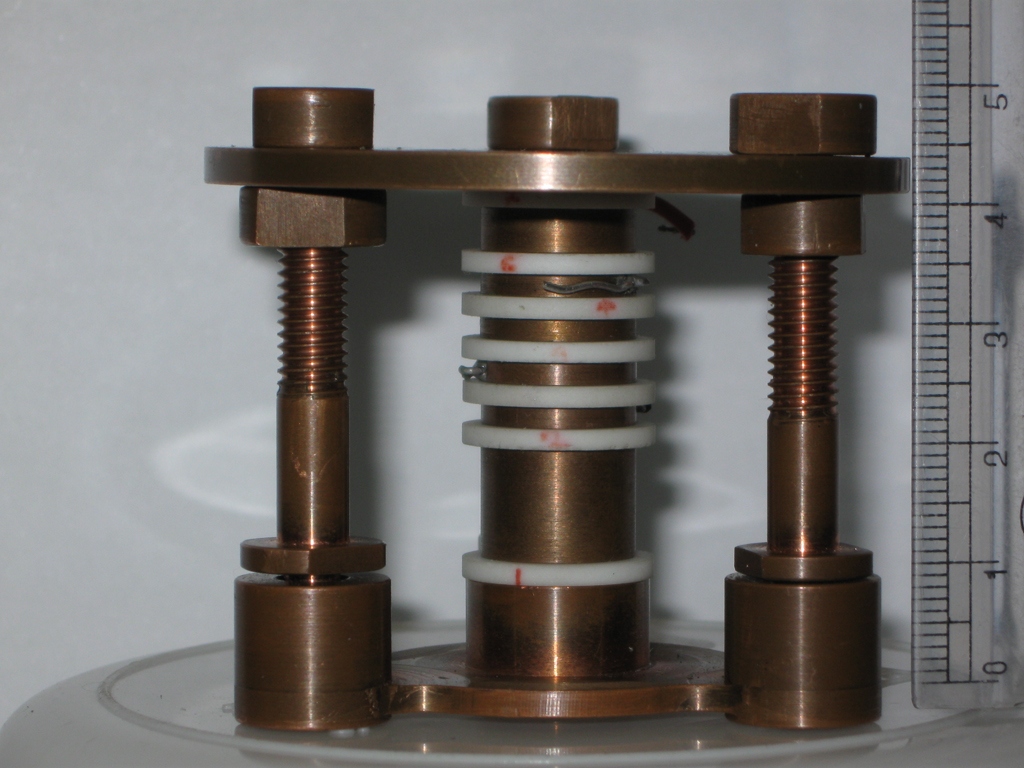
Penning trap is a device to store charged ions and sub-atomic particles. In a homogeneous magnetic field, a charged particle would undergo circular motion and be radially confined, but it would not be axially confined. It can be shown that a charged particle can be trapped both radially and axially by putting it in a strong homogeneous magnetic field and weak inhomogeneous (electrostatic potential being quadratic with the axial and radial distances from the center) electrostatic field. Under the action of such magnetic and electric fields, a charged particle undergoes a complicated motion comprising axial oscillation, cyclotron motion and magnetron motion. The frequencies of the axial and cyclotron motions depend on the mass of the charged particle. Since it is possible to measure frequencies very accurately, one can measure the mass of the trapped charged particle very accurately by undertaking precision measurements of its axial and cyclotron frequencies. Usually Penning traps are used for high precision mass measurements of the charged particles. However Penning traps are also used for many other purposes such as quantum computation, neutrino-electron angular correlation studies in beta decay etc.
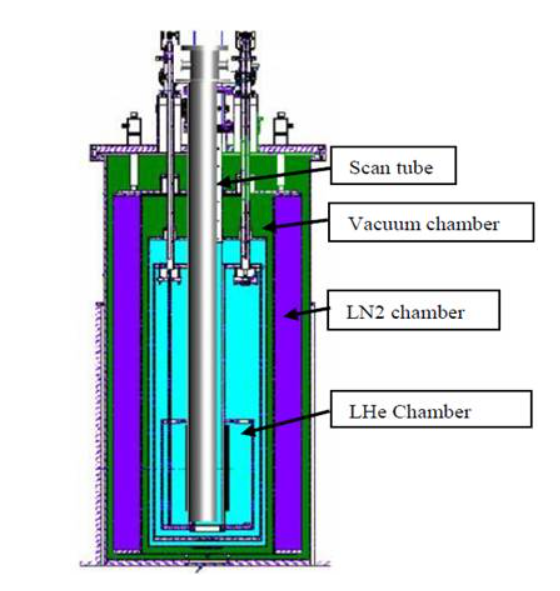
At VECC, we are building a cryogenic Penning trap facility where the trap would be at liquid helium (4 K) temperature and plan to put in radioactive ions in it. In addition to mass measurements, our emphasis would be to measure the kinetic energies of the recoiled nuclei from the beta decay and electron capture processes. In this way, we plan to measure Q-values of the beta decay processes with high precision using our Penning trap system. Such high precision Q-value measurements of beta decay processes are required for various tests of Standard model (such as the unitarity of CKM matrix elements). Very high precision measurements of the end-point of the recoil nuclei from the beta decay processes might also provide us a new method to directly measure the mass of an electron neutrino.
High-energy photon spectrometer
Electromagnetic radiation produced in nuclear reactions has been an important subject of study since the beginning of nuclear science. Since, the electromagnetic radiation is not seriously affected by the nuclear medium, it is the most suitable probe of choice to the study the properties of nuclear systems. In order to measure the high-energy gamma rays from hot nuclear systems, the following two detector systems (LAMBDA & GAMMA) have been developed in-house and are currently being used.
Charged Particle Detector Array (CPDA)
A 4pi-charged particle detector array is being developed at VECC. The array will consist of three parts: (a) the forward array covering 7 to 45 degree with silicon-silicon-CsI(Tl) telescopes, (b) extreme forward array covering 3 to 7 degree with phoswich detectors and (c) the backward array covering 45 to 175 degree with 330 CsI(Tl) crystals.
The forward array will consist of 24 Silicon-Silicon-CsI(Tl) telescopes, each composed of a 50 micron thick silicon strip (16 segments) detector (delE1), a 500 micron/1 mm ( delE2/ E) thick double sided (16 x 16 segments) silicon strip detector (DSSD), and four 6 cm thick CsI(Tl) detectors.(E). Thus, the E detector will provide two dimensional position information as well as good isotopic identification for the fragments with (Z < 10) produced in low and intermediate energy heavy-ion reactions. In addition to good isotopic resolution, it will also provide a low energy threshold for particle identification. The CsI(Tl) detectors will detect proton of maximum energy of E/A = 140 MeV and 16O ions of energy E/A = 335 MeV respectively. The angular coverage of the forward array would be ~ 7o -45o. The CsI(Tl) crystals are trapezoidal in shape, having 2.5 x 2.5 cm2 front face and 3.5 x 3.5 cm2 back face respectively and coupled to a photodiode due to the excellent linearity of the photodiode over a wide dynamic range and compact size.
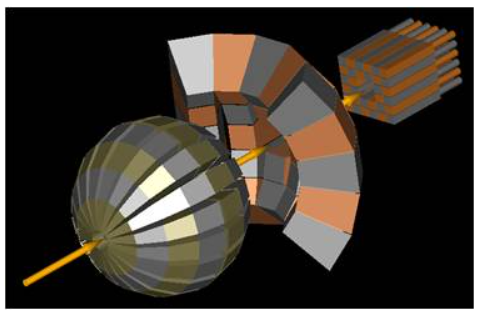
Design view of the CPDA
In-beam performance of a prototype telescope of the forward array has been tested with145 MeV 20Ne beam at VECC. All Strips and the CsI(Tl) detectors were read out individually using standard readout electronics and a VME-based online data acquisition system developed at VECC to collect data on event-by-event basis.
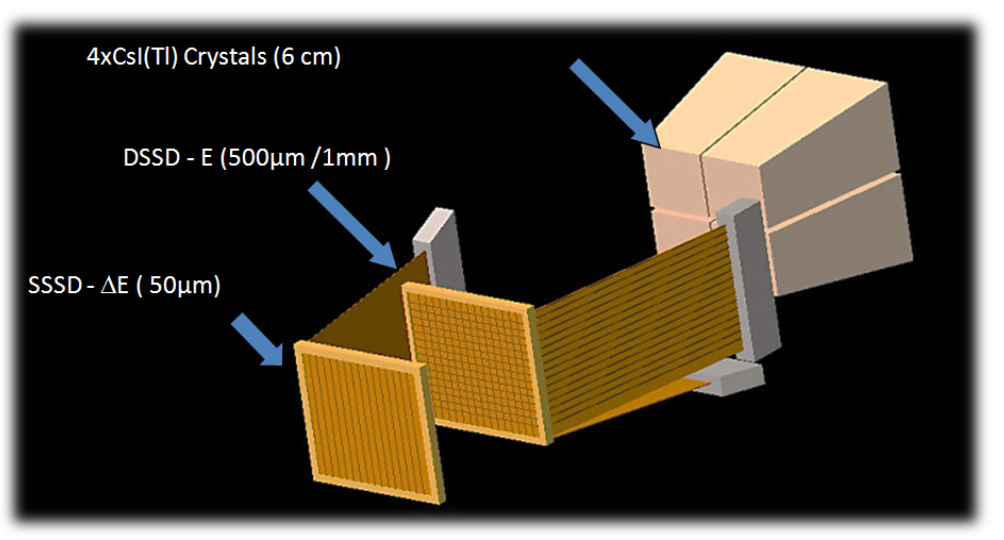
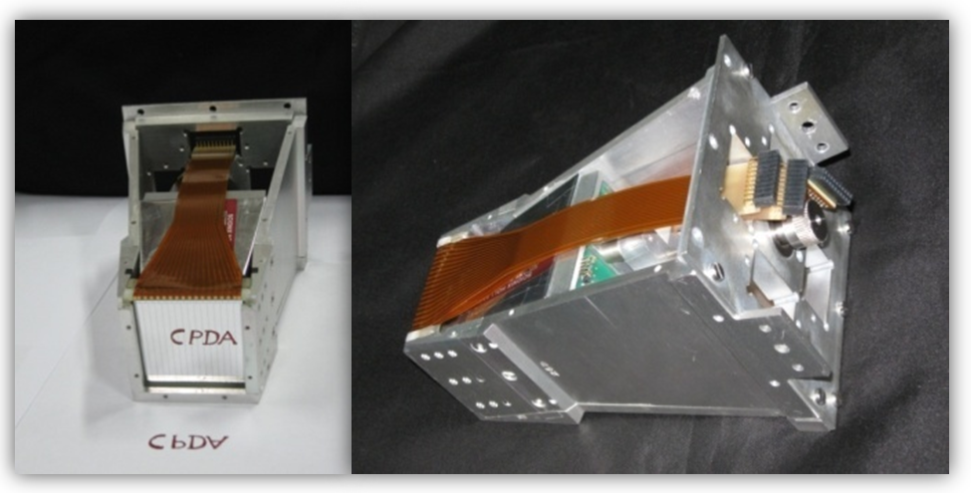
The extreme forward array which will cover the angular range of 3o -7o, will be made up of 32 phoswitch detectors (combinations of fast and slow plastic scintillators).
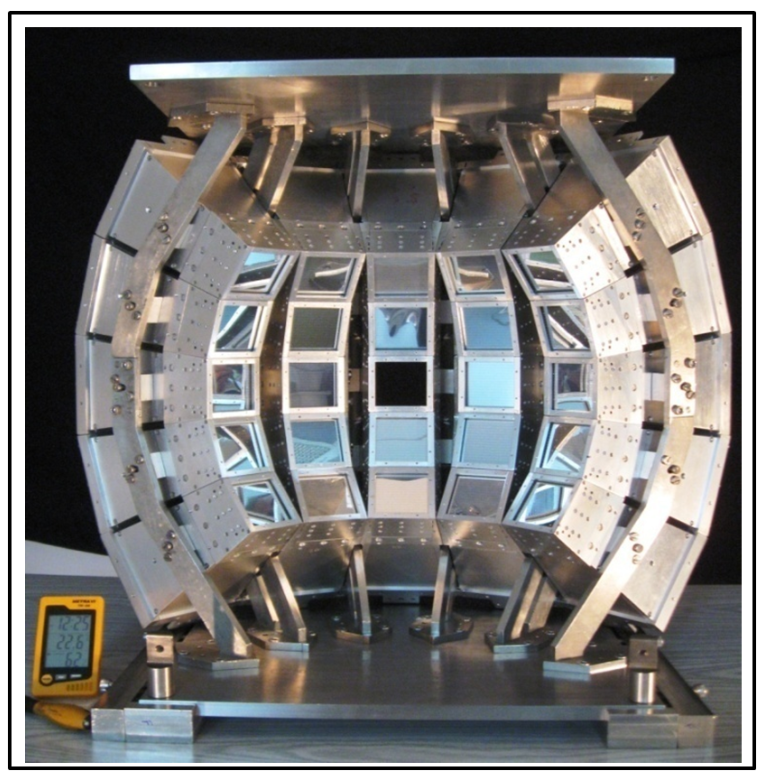
Photograph of the Charged Particle Detector Array (CPDA)
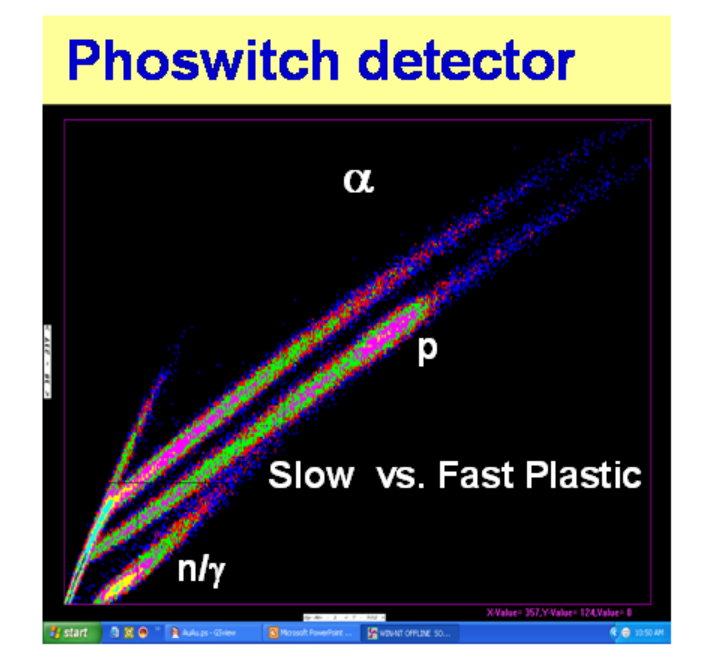
The decay time for the fast plastic scintillator is 2 ns while that for slow plastic is 280 ns. Prototype plastic phoswich detectors have been developed, which consist of fast and slow plastic of thickness 200 mm and 100 mm respectively. The phoswitch detectors were then optically coupled to a low power photomultiplier tube to collect the scintillation light. Typical energy thresholds in 200mm fast scintillators for different ionizing particles are ~4MeV for proton, ~4MeV/A for alpha and ~7MeV/A for 16O. In - beam performance of these detectors have been carried out using 145MeV 20Ne ion beam from the Variable Energy Cyclotron, Kolkata, on a mylar target and the particle separation obtained is shown below.
The backword part, covering the angular range 45 degree to 175 degree will consists of 300 CsI(Tl) crystals of different size and shape.
| S.No | Title | Date | Speaker |
| 1 | Carbon Research in India's Nuclear Energy Program | Dr. Kinshuk Dasgupta, Bhabha Atomic Research Centre | |
| 2 | Facility for Anti-proton & Ion Research (FAIR) | Dr. Subhasis Chattopadhyay, GSI, Darmstadt | |
| 3 | A practical framework for perturbative corrections to few-body | Shri Sourav Mondal, IIT Guwahati | |
| 4 | Problems with Proton's low-energy structure and connections to Two-Photon Exchange in Lepton-Proton Scattering | Prof. Udit Raha, Dept. of Physics, IIT Guwahati | |
| 5 | Investigation of Reaction Mechanisms in Heavy-Ion Collisions Using the CORSET Time-of-Flight Spectrometer | Prof. Alexey Bogachev, JINR, Dubna, Russia | |
| 6 | Spectroscopy of Rare Isotope Fragments: Expanding Experimental Horizons | Prof. Partha Chowdhury, University of Massachusetts Lowell, USA | |
| 7 | Transport Coefficients of Hot Hadronic Matter | Utsab Gangopadhyaya | |
| 8 | Evolution of perturbation in a hydrodynamically expanding system formed in relativistic heavy ion collision | Golam Sarwar | |
| 9 | Non-extensive Drag and diffusion Coefficients of the heavy quarks travelling through non-Abelian Plasma | Dr Trambak Bhattacharyya,Bogoliubov Laboratory of Theoretical Physics, JINR, Dubna, Russa. | |
| 10 | Study of direct photon production from relativistic heavy ion collisions | Pingal Dasgupta | |
| 11 | Equations of states for white dwarfs and neutron stars | Somnath Mukhopadhyay | |
| 12 | Nuclear Structure Studies in Mass Region A~60-70 | Dr Siddarth Rai | |
| 13 | Micro-Pattern Gaseous Detectors – Device Physics and Potential Applications | Purba Bhattacharya | |
| 14 | Search for the Vortical and the Chiral Magnetic Effects at the Relativistic Heavy Ion Collider | Prithwish Tribedy | |
| 15 | Surface and interface modification by low energy ion beams | Dipak Bhowmik | |
| 16 | Measurement of azimuthal correlations between D-mesons and charged particles in pp collisions at {sqrt}s = 13TeV with ALICE at the LHC | Samrangy Sadhu | |
| 17 | Nuclear structure far from stability: science and techniques | Prof. Partha Chowdhuri of University Of Massachusetts Lowell, USA | |
| 18 | Spectral properties of hadrons in a magnetized medium | Snigdha Ghosh | |
| 19 | Possibility to develop a detection system for elusive particles at FRENA | Tilak Kumar Ghosh | |
| 20 | 'Heavy' breaking of boost invariance by heavy quarks in relativistic heavy ion collisions | Sandeep Chatterjee, AGH University of Science and Technology, Poland | |
| 21 | Study of Nuclear Structure around N=90 | Arunabha Saha | |
| 22 | Study of nuclear viscosity and isospin mixing utilizing isovector giant dipole resonance | Debasish Mondal | |
| 23 | Understanding The Thermodynamics of Strongly Interacting Systems in Effective QCD Models | Soumitra Maity, Bose Institute |
| Article | Author | Journal/Symposium | Year |
| Gamma-ray spectroscopy using deuterated liquid scintillator EJ315 detector | S Dalal, K Banerjee, G Mukerjee, TK Rana, P Roy, S Manna, S Roy, R Shil, SR Singh, P Pant, S Adhikary, S Kundu, TK Ghosh, A Sen, R Pandey, B Layek, S Sadhukhan, S Dawn | Nuclear Instruments and Methods in Physics Research A 1084 (2026) 171275 | 2026 |
| Synthetic data driven comprehensive machine learning framework for digital neutron-gamma discrimination | RK Paul, R Bhattacherjee, A Banerjee, K Banerjee, P Roy, R Shil, P Dhara, T Samanta | Nuclear Instruments and Methods in Physics Research Section A 1087 (2026) 171456 | 2026 |
| Depth-dependent background neutron distribution at the deep underground laboratory | Sujoy Chatterjee, K Banerjee, S Dawn, Arijit Sen, S Manna, AK Bakshi, Pratap Roy, VN Jha, R Datta, BK Sapra | Physics Letter B 875 (2026) 140337 | 2026 |
| Measurement of scintillation light output of a 5′′× 5′′ EJ-276D plastic scintillator detectors using quasi-monoenergetic neutrons | Pankaj Pant, K Banerjee, P Roy, R Shil, SR Singh, S Adhikary, S Roy, S Sadhukhan, B Layek, S Manna, TK Rana, S Kundu | Nuclear Instruments and Methods in Physics Research Section A 1092 (2026) 171857 | 2026 |
| Evidence for high shell-damping rate in bismuth nuclei using a systematic analysis of nuclear level density | R Shil, K Banerjee, J Sadhukhan, Pratap Roy, A Chakraborty | Physical Review C 114 (2026) 014633 | 2026 |
| Role of magicity in the low temperature evolution of IVGDR width in Te isotopes | Saumanti Sadhukhan, S Mukhopadhyay, Debasish Mondal, Jhilam Sadhukhan, Chandrani Sen, S Adhikary, Deepak Pandit, Pratap Roy, Surajit Pal, R Shil, Saswata Roy, S Bhattacharyya, K Banerjee, D Paul, TK Rana, Samir Kundu, P Karmakar, A De, B Dey, Srijit Bhattacharya, S Chakraborty, S Manna, A Sen, S Bagchi, M Abdullah, K Khokhar, D Kar | Physics Letter B 880 (2026) 140695 | 2026 |
| Coexistence of single-particle and collective states in 116Sb | Shabir Dar, Soumik Bhattacharya, S. Bhattacharyya, G. H. Bhat, S. Jehangir, J. A. Sheikh, R. Banik, S. Nandi, G. Mukherjee, Sajad Ali, S. Chakraborty , S. Chatterjee, S. Das, S. Das Gupta, A. Dhal, S. S. Ghugre, A. Goswami, D. Mondal, S. Mukhopadhyay, S. Pal, D. Pandit, R. Raut, P. Ray, | Physical Review C 111 (2025) 14328 | 2025 |
| Preparation of selenium target using sedimentation method for in-beam gamma-ray spectroscopic measurement | R. Mondal Saha, K. Banerjee, A. Chakraborty, N. Gayathri, Souvik Jana, Satya Samiran Nayak, G. R. Umapathy, Anirban Basak, S. Bhattacharyya, R. Shil, Satyajit Hazra, Saif Ahmad Khan | Nuclear Instruments and Methods in Physics Research Section A 1074 (2025) 170288 | 2025 |
| Searching for initial state fluctuations in heavy ion collisions at FAIR energy using principal component analysis | Ekata Nandy, Subhasis Chattopadhyay | The European Physical Journal A 61 (2025) 39 | 2025 |
| Design of GAMMAGAMMA fast timing setup VENTURE-2.0 with CeBr3 detectors | A. Pal, P. Behre, M. K. Jha, S. Basak, Devesh Kumar, S.S. Alam, S. Roy, J. -M. Regis, T. Bhattacharjee and T. Bhattacharjee | Journal of Instrumentation 20 (2025) P02022 | 2025 |
| New evidence of interplay between tetrahedral and octahedral symmetries and symmetry breaking: Exotic rotational bands in 152Sm | S. Basak, D. Kumar, T. Bhattacharjee, I. Dedes, J. Dudek, A. Pal , S. S. Alam, A. Saha , A. K. Sikdar, J. Nandi, Shabir Dar, A. Baran, A. Gaamouci, D. Rouvel, S. Samanta, S. Chatterjee, R. Raut, S. S. Ghugre, A. Adhikari, Y. Sapkota, R. Rahaman, Ananya | Physical Review C 111 (2025) 34319 | 2025 |
| First in-beam experiment in K500 superconducting cyclotron at VECC | T.K. Rana, Samir Kundu, S. Manna, K. Banerjee, P. Karmakar, T.K. Ghosh, G. Mukherjee, A. Sen, R. Pandey, P. Pant, Pratap Roy, R. Shil, S.S. Nayak, K. Rani, K. Atreya, D. Paul, R. Santra, A. Sultana, S. Pal, S. Basu, Deepak Pandit, S. Mukhopadhyay, C. Bhattacharya, J. Debnath, U. Bhunia, M.K. Dey | Nuclear Physics A 1060 (2025) 123101 | 2025 |
| Rotational band based on πf7/2 orbital in 55Mn | S. Basu, G. Mukherjee, S. Nandi, S.S. Nayak, S. Bhattacharyya, S. Chakraborty, Soumik Bhattacharya, S. Pal, Shabir Dar, Sneha Das, S. Basak, D. Kumar, Pratap Roy, D. Paul, K. Banerjee, S. Manna, Samir Kundu, T.K. Rana, R. Pandey, S. Samanta, S. Ali | Nuclear Physics A 1059 (2025) 123092 | 2025 |
| Shape transition and development of triaxiality in 154Tb | N. Susshma, R. Gowrishankar, S. Deepa, K. Vijay Sai, S. Chatterjee, A. Sharma, S.S. Ghugre, Shabir Dar, S. Das, S. Basu, S. Nandi, S. Bhattacharya, S.S. Nayak, G. Mukherjee, S. Bhattacharyya, R.P. Singh, G.H. Bhat, J.A. Sheikh, S. Jehangir, R. Raut | Nuclear Physics A 1055 (2025) 123019 | 2025 |
| The FRENA accelerator and its beam energy calibration | A. Banerjee, K. Banerjee, R. Shil, Pratap Roy, P. Pant, C. Basu, G. Mukherjee, T.K. Ghosh | Nuclear Instruments and Methods in Physics Research Section A 1072 (2025) 170179 | 2025 |
| Addendum: Dielectron production in proton-proton and proton-lead collisions at √sNN=5.02TeV | ALICE Collaboration | Physical Review C 111 (2025) 24905 | 2025 |
| Probing Strangeness Hadronization with Event-by Event Production of Multistrange Hadrons | ALICE Collaboration | Physical Review Letters 134 (2025) 22303 | 2025 |
| Particle production as a function of charged-particle flattenicity in pp collisions at √s=13 TeV | ALICE Collaboration | Physical Review D 111 (2025) 12010 | 2025 |
| Energy dependence of polarized yy→e+e− in peripheral Au+Au collisions at √sNN=54.4 and 200 GeV with the STAR experiment at RHIC | STAR Collaboration | Physical Review C 111 (2025) 14909 | 2025 |
| Measurement of directed flow in Au+Au collisions at √sNN=19.6 and 27 GeV with the STAR event plane detector | STAR Collaboration | Physical Review C 111 (2025) 14906 | 2025 |
| First Measurement of A=4 Hypernuclei and Antihypernuclei at the LHC | ALICE Collaboration | Physical Review Letters 134 (2025) 162301 | 2025 |
| Testing a large size triple GEM detector for the first station of the CBM-Muon Chambers with a high-intensity gamma source at GIF++ under large-area illumination | Apar Agarwal, Souvik Chattopadhay, Pawan Kumar Sharma, Anand Kumar Dubey, Jogender Saini, Vikas Singhal, Vinod Negi, Ekata Nandy, Chandrasekhar Ghosh, David Emschermann, Zubayer Ahammed and Subhasis Chattopadhyay | Journal of Instrumentation 20 (2025) P04022 | 2025 |
| Measurement of ω meson production in pp collisions at √s = 13 TeV | ALICE Collaboration | Journal of High Energy Physics 2025 (2025) 1 | 2025 |
| Performance of a real-size, low resistivity resistive plate chamber at GIF++ Using self-trigger electronics for the Muon Chamber of the CBM Experiment | Souvik Chattopadhay, Apar Agarwal, Ekata Nandy, Jogender Saini, Anand Kumar Dubey, Shuaib Ahmad Khan, Subhasis Chattopadhyay and Zubayer Ahammed | Journal of Instrumentation 20 (2025) P03009 | 2025 |
| Reexamination of eccentricity scaling of elliptic flow and incomplete thermalization scenario in heavy-ion collisions at energies available at CERN large hadron collider | 22. Arun Kumar Yadav, Partha Pratim Bhaduri and Subhasis Chattopadhyay | The European Physical Journal C 85 (2025) 1 | 2025 |
| A systematic study of initial state quark energy loss in fixed target proton nucleus collisions | Sourav Kanti Giri, Partha Pratim Bhaduri, Biswarup Paul & Santosh K. Das | The European Physical Journal C 85 (2025) 1 | 2025 |
| Medium-induced modification of groomed and ungroomed jet mass and angularities in Pb–Pb collisions at √sNN= 5.02 TeV | ALICE Collaboration | Physics Letters B 864 (2025) 139409 | 2025 |
| Multimuons in cosmic-ray events as seen in ALICE at the LHC | ALICE Collaboration | Journal of Cosmology and Astroparticle Physics 2025 (2025) 1 | 2025 |
| First observation of strange baryon enhancement with effective energy in pp collisions at the LHC | ALICE Collaboration | Journal of High Energy Physics 2025 (2025) 1 | 2025 |
| Multiplicity-dependent jet modification from dihadron correlations in pp collisions at √s= 13 TeV | ALICE Collaboration | Journal of High Energy Physics 2025 (2025) 1 | 2025 |
| Rapidity dependence of antideuteron coalescence in pp collisions at √s =13 TeV with ALICE | ALICE Collaboration | Physics Letters B 860 (2025) 139191 | 2025 |
| Measurement of the inclusive isolated-photon production cross section in pp collisions at √s =13 TeV | ALICE Collaboration | The European Physical Journal C 85 (2025) 1 | 2025 |
| Measurement of HΛ3 production in Pb–Pb collisions at √sNN=5.02 TeV | ALICE Collaboration | Physics Letters B 860 (2025) 139066 | 2025 |
| Investigating Λ baryon production in p-Pb collisions in jets and the underlying event using angular correlations | ALICE Collaboration | Physical Review C 111 (2025) 15201 | 2025 |
| Measurement of radiative decay width of the Hoyle state of 12C via 12C(p, p′)12C reaction | T.K. Rana, Deepak Pandit, S. Manna, Samir Kundu, K. Banerjee, A. Sen, R. Pandey, G. Mukherjee, T.K. Ghosh, S.S. Nayak, R. Shil, P. Karmakar, K. Atreya, K. Rani, D. Paul, R. Santra, A. Sultana, S. Basu, S. Pal, S. Sadhukhan, Debasish Mondal, S. Mukhopa | Nuclear Physics A 1060 (2025) 123133 | 2025 |
| Comparison of various pulse height unfolding methods used in fast neutron spectroscopy | S. Dalal, K. Banerjee, S. Chatterjee, P. Roy, A.S. Roy, R. Shill, Sandipan Dawn | Journal of Instrumentation 20 (20250) P05006 | 2025 |
| First measurement of Ds1(1+) (2536)+ and D*s2(2+) (2573)+ production in proton-proton collisions at √s=13 TeV at the LHC | ALICE Collaboration | Physical review D 111 (2025) 112005 | 2025 |
| Decay of 131La | S. Banerjee, S. Bhattacharyya, S. Chakraborty, Soumik Bhattacharya, G. Mukherjee, S.S. Nayak, Snigdha Pal, Suchorita Paul, A. Pal, D. Kumar, R. Banik, S. Panwar, S. Basu, S. Das Gupta, R. Raut, S.S. Ghugre, Pankaj K. Giri, A. Sharma, S. Kundu, C. Majumder, A. Karmakar, S. Rajbanshi, S. Ganguly, H. Rahaman | Nuclear Physics A 1061 (2025) 123144 | 2025 |
| Proton emission in ultraperipheral Pb-Pb collisions at √sNN=5.02 TeV | ALICE Collaboration | Physical review C 111 (2025) 54906 | 2025 |
| Higher-order symmetry plane correlations in Pb-Pb collisions at √sNN=5.02TeV | ALICE Collaboration | Physical review C 111 (2025) 64913 | 2025 |
| Search for Quasiparticle Scattering in the QuarkGluon Plasma with Jet Splittings in pp and Pb-Pb Collisions at √sNN=5.02 TeV | ALICE Collaboration | Physical review Letters 135 (2025) 31901 | 2025 |
| Conclusive evidence of a two-neutron multiphonon transverse wobbling mode in 82Kr | S. Rajbanshi, R. Palit, Habibur Rahaman, G. Manna, Sajad Ali, S. Chakraborty, G. H. Bhat, S. Jehangir, J. A. Sheikh, F. S. Babra, R. Banik, S.Bhattacharya, S. Bhattacharyya, P. Dey, Md. S. R. Laskar, G. Mukherjee, S. Nandi, H. Pai, Rajkumar Santra, and T. Trivedi | Physical review C 111 (2025) L061301 | 2025 |
| Effect of N/Z asymmetry on pre-equilibrium and equilibrium emission of light charged particles | S. Manna, Pratap Roy, T. K. Rana, S. Kundu, R. Pandey, K. Banerjee, A. Sen, T. K. Ghosh, G. Mukherjee, S. Mukhopadhyay, P. Karmakar, D. Paul, S. Dalal, and C. Bhattacharya | Physical review C 112 (2025) 14613 | 2025 |
| Measurement of In-Medium Jet Modification Using Direct Photon + Jet and pi0+ Jet Correlations in p+p and Central Au+Au Collisions at √sNN=200 Ge | STAR Collaboration | Physical review Letters 134 (2025) 232301 | 2025 |
| Multimodal fission of 201Tl | A. Sultana, A. Sen, T. K. Ghosh, D. Paul, K. Atreya, K. Banerjee, Jhilam Sadhukhan, Gourab Banerjee, D. Mondal, G. Mukherjee, P. Karmakar, R.Shil, R. Pandey, Samir Kundu, S. Mukhopadhyay, S. Manna, S. S. Nayak, S. Basu, Shabir Dar, T. K. Rana, and C. Bhattacharya | Physical review C 112 (2025) 14617 | 2025 |
| Semi-inclusive direct photon + jet and pi0+jet correlations measured in p + p and central Au+Au collisions at √sNN=200GeV | STAR Collaboration | Physical review C 111 (2025) 64907 | 2025 |
| Exhibition of multiple band structures of different kind in 142Eu | Sajad Ali, S. Rajbanshi, Somnath Nag, S. Bhattacharyya, S. Chattopadhyay, A. Goswami, G. Mukherjee, R. Palit, S. Saha , J. Sethi, A. K. Singh, T. Trivedi | Physical Review C 111 (2025) 24303 | 2025 |
| Measurement of the production cross section of prompt Ξ0c baryons in p−Pb collisions at √sNN=5.02 TeV | ALICE Collaboration | The European Physical Journal C 85 (2025) 86 | 2025 |
| Multiplicity dependence of Υ production at forward rapidity in pp collisions at √s= 13 TeV | ALICE Collaboration | Nuclear Physics B 1011 (2025) 116786 | 2025 |
| Beta-delayed neutron spectroscopy of 85,86As with MONSTER at IGISOL | A. Perez de Rada Fiol, T. Martinez, D. Cano-Ott, H. Penttila, J. Agramunt, V. Alcayne, A. Algora, S. Alhomaidhi, J. Aysto, K. Banerjee, O. Beliuskina, J. Benito, C. Bhattacharya, F. Calviño, G. Cortés, R. P. de Groote, A. de Roubin, C. Delafosse, C. Domingo-Pardo, S. Geldhof, W. Gins, M. Hukkanen, A. Jokinen, A. Kankainen, J. Lerendegui-Marco, J. Llanes Gamonoso, I. Matea, E. Mendoza, A. K. Mistry, D. A. Nesterenko, J. Plaza, I. Pohjalainen, S. Rinta-Antila, P. Roy, A. Sanchez-Caballero, J. L. Tain, D. Villamarín,M. Vilen | Physical Review C 111 (2025) 44312 | 2025 |
| Common femtoscopic hadron-emission source in pp collisions at the LHC | ALICE Collaboration | The European Physical Journal C 85 (2025) 198 | 2025 |
| Study of the giant dipole resonance around the magic number 28 | Chandrani Sen, Debasish Mondal, Gourab Banerjee, S. Mukhopadhyay, Jhilam Sadhukhan, Deepak Pandit, Surajit Pal, Sujan Kumar Roy, Balaram Dey, Srijit Bhattacharya, A. De, Pratap Roy, T.K. Rana, Rajkumar Santra, Saumanti Sadhukhan | Physics Letters B 868 (2025) 139652 | 2025 |
| Nuclear Physics A 1062 (2025) 123171 | Pankaj K. Giri, Sandipan Dasgupta, A. Sharma, S. Kundu, A. Das, S. S. Ghugre, G. Mukherjee, S. Bhattacharyya, J. Datta, R. Raut | Excitation functions of (α, xn) reactions in natural Sb | 2025 |
| Design and development of a versatile remote controllable pulse shape discriminator for liquid and new generation plastic scintillator detectors | S. Dalal, K. Banerjee, P. Roy, R.K. Paul, A. K. Saha, P. Bhaskar | Journal of Instrumentation 20 (2025) P10029 | 2025 |
| Enhanced multi-strange hadron productions in Cu+Cu collisions at √sNN=200GeV | Apar Agarwal, Purabi Ghosh, Sushant K. Singh, Santosh K. Agarwalla, Anand Kumar Dubey, Jajati K. Nayak | Journal of Subatomic Particles and Cosmology 4 (2025) 100214 | 2025 |
| Cold nuclear matter effects and J/ψ production in fixed target proton– nucleus (p+A) collisions | Sourav Kanti Giri, Partha Pratim Bhaduri, Biswarup Paul, Santosh K. Das | Journal of Subatomic Particles and Cosmology 4 (2025) 100132 | 2025 |
| Revisit of eccentricity scaling of elliptic flow and incomplete thermalization scenario in heavy-ion collisions at energies available at CERN large hadron collider | 56. Arun Kumar Yadav, Partha Pratim Bhaduri, Subhasis Chattopadhyay | Journal of Subatomic Particles and Cosmology 4 (2025) 100251 | 2025 |
| Design, fabrication and testing of real size MuCh second station GEM module prototype for CBM experiment at FAIR, Germany | Chandrasekhar Ghosh, Shruti Gudla, Jogender Saini, Anand Kumar Dubey, Arup Bandyopadhyay | Journal of Subatomic Particles and Cosmology 4 (2025) 100262 | 2025 |
| Measurement of electrons from beauty-hadron decays in pp collisions from √s = 2.76 TeV to 13 TeV with ALICE | ALICE Collaboration | Journal of Subatomic Particles and Cosmology 4 (2025) 100238 | 2025 |
| Hyperon global polarization in isobar Ru+Ru and Zr+Zr collisions at √sNN = 200 GeV | STAR Collaboration | Physics Letters B 870 (2025) 139891 | 2025 |
| Conclusive evidence of magnetic rotational band in 57Fe: Extending the shears mechanism to the fp shell orbital | S. Basu, G. Mukherjee, S. Rajbanshi, Y. Utsuno, Noritaka Shimizu, S. Nandi, S. S. Nayak, S. Pal, S. Bhattacharyya, S. Chakraborty, Soumik Bhattacharya, Shabir Dar, Sneha Das, S. Basak, D. Kumar, D. Paul, K. Banerjee, Pratap Roy, S. Manna, Samir Kundu, T.K. Rana, R. Pandey, S. Samanta, S. Chatterjee, R. Raut, S. S. Ghugre, H. Pai, A. Karmakar, S. Chattopadhyay, S. Das Gupta, P. Pallav, R. Banik, S. Ali, Y. M. Wang, Q.B. Chen | Physics Letters B 868 (2025) 139642 | 2025 |
| Coherent J/ψ photoproduction at midrapidity in PbPb collisions at √sNN = 5.02 TeV | ALICE Collaboration | Physics Letters B 871 (2025) 139952 | 2025 |
| First measurement of symmetric cumulants of hexagonal flow harmonicsin Pb-Pb collisions at root sNN =5.02 TeV | ALICE Collaboration | Physical Review C 112 (2025) 24905 | 2025 |
| Measurement of w meson production in pp and p-Pb collisions at root sNN =5.02 TeV | ALICE Collaboration | Physical Review C 112 (2025) 44904 | 2025 |
| D0-meson-tagged jet axes difference in proton proton collisions at √s=5.02 TeV | ALICE Collaboration | Physical Review D 112 (2025) 92012 | 2025 |
| Dielectron production in central Pb-Pb collisions at √sNN=5.02 TeV | ALICE Collaboration | Physical Review C 112 (2025) 54906 | 2025 |
| Observation of the Ω(2012) baryon at the LHC | ALICE Collaboration | Physical Review D 112 (2025) 92002 | 2025 |
| Level structure of light neutron-rich La isotopes beyond the N=82 shell closure | A. Navin, E. H. Wang , S. Bhattacharyya , Menglan Liu , Cenxi Yuan , M. Rejmund, A. Lemasson , S. Biswas, Y. H. Kim, C. Michelagnoli , J. H. Hamilton , A. V. Ramayya, I. Stefan , R. Banik, P. Bednarczyk , Soumik Bhattacharya , E. Clément , H. L. Crawford , G. de France , P. Fallon, G. Frémont, J. Goupil, B. Jacquot, H. J. Li, J. Ljungvall , Y. X. Luo , A. Maj , L. Ménager, V. Morel, G. Mukherjee , R. Palit, R. M. Pérez-Vidal , J. O. Rasmussen, J. Ropert, C. Schmitt , S. J. Zhu | Physical Review C 112 (2025) 44310 | 2025 |
| Global optimization of nuclear level density parameters using Bayesian analysis | R. Shil, G. Banerjee, K. Banerjee, J. Sadhukhan, Pratap Roy, A. Chakraborty | Physical Review C 112 (2025) 44609 | 2025 |
| Structural evolution and K mixing in 52Cr: A shell model description | Arkadip Bera, Abhijit Bisoi, Rozina Rahaman, Y. Sapkota, Arkabrata Gupta, Sangeeta Das, Ananya Das, Dibyadyuti Pramanik, S. Rajbanshi, A. Pal, S. Basak, Sansaptak Basu, S. S. Nayak, D. Kumar, S. Bhattacharya, T. Bhattacharjee, S. Chakraborty, G. Mukherjee, S. Bhattacharyya, A. Sharma, S. Kundu, Pankaj K. Giri, R. Raut, S. S. Ghugre | Physical Review C 112 (2025) 44305 | 2025 |
| Symmetry energy and isoscaling behavior of fragments emitted in 14N, 20Ne + 112,116,124Sn at 18–30 MeV/nucleon | Payel Karmakar, Samir Kundu, T. K. Rana, S. Mallik, S. Manna, Ratnesh Pandey, K. Banerjee, Pratap Roy, S. Mukhopadhyay, Arijit Sen, T. K. Ghosh, P. Pant, G. Mukherjee, A. Sultana, D. Mondal, D. Pandit, R. Shil, K. Rani | Physical Review C 112 (2025) 24614 | 2025 |
| Measurements of Y states production in p+ p collisions at √s =500 GeV with STAR: Cross sections, ratios, and multiplicity dependence | STAR Collaboration | Physical Review D 112 (2025) 32004 | 2025 |
| Precision Measurement of Net-Proton-Number Fluctuations in Au+Au Collisions at RHIC | STAR Collaboration | Physical Review Letters 135 (2025) 142301 | 2025 |
| Onset of Constituent Quark Number Scaling in Heavy-Ion Collisions at RHIC | STAR Collaboration | Physical Review Letters 135 (2025) 72301 | 2025 |
| “Development and Characterization of Digital Light Processing-Based 3DPrinted Plastic Scintillator for Radiation Detection | V. Anand, K. Banerjee, G. Bizarri, Ritika Datta, G. Anil Kumar | IEEE Transactions on Nuclear Science 72 (2025) 1947 | 2025 |
| Effect of isolation criteria on prompt photon production in relativistic nuclear collisions | Sinjini Chandra, Rupa Chatterjee, Zubayer Ahammed | Physical Review C112 (2025) 64915 | 2025 |
| Development and Characterization of a Cryogenic Tuned Amplifier for Penning Trap Applications | Niraj Chaddha, A. K. Sikdar, J. Nandi, C. H. Vyshnav, M. Chatterjee, P. Das, A. Ray | Journal of Low Temperature Physics 220 (2025) 281 | 2025 |
| Thermocoalescence model for light nuclei production in relativistic heavy-ion collisions | Arun Kumar Yadav, Nachiketa Sarkar, Sudhir Pandurang Rode, Partha Pratim Bhaduri, Abhijit Bhattacharyya and Amaresh Jaiswal | The European Physical Journal C 85 (2025) 1361 | 2025 |
| Name | Contact Number | Member Details | |
| Zubayer Ahammed | 2318 | za@vecc.gov.in | Details |
| Jogender Saini | 2414 | jsaini@vecc.gov.in | Details |
| Subrata Kumar Ghosh | 4315 | sk.ghosh@vecc.gov.in | Details |
| Ganesh Das | 2320 | Details | |
| Jayant Kumar | 2502 | jayant@vecc.gov.in | Details |
| Nilay Kr Bhowmik | 2315 | bhowmik.n@vecc.gov.in | Details |
| Anand Kumar Dubey | 2416 | anand@vecc.gov.in | Details |
| Prasun Singh Roy | 2222 | prasun@vecc.gov.in | Details |
| Nilima Mondal | 2320 | nilima@vecc.gov.in | Details |
| Tushar Kanti Das | 2601 | tdas@vecc.gov.in | Details |
| Arun Kumar Yadav | 2301 | ak.yadav@vecc.gov.in | Details |
| Dr. Sinjini Chandra | 033 2318 2425 | s.chandra@vecc.gov.in | Details |
| Ekata Nandy | 2425 | ekata@vecc.gov.in | Details |
| Shuaib Ahmad Khan | 2419 | shuaibkhan@vecc.gov.in | Details |
| Sanjib Muhuri | 033 2318 2424/2417 | sanjibmuhuri@vecc.gov.in | Details |
| Partha Pratim Bhaduri | 2314 | partha.bhaduri@vecc.gov.in | Details |
| Vikas Singhal | 033 2318 2424 | vikas@vecc.gov.in | Details |
| Suman Barat | 0000 | suman.barat@vecc.gov.in | Details |
| Anamika Pallavi | 2419 | a.pallavi@vecc.gov.in | Details |
| Dipayan Das | 2418 | dipayan.das@vecc.gov.in | Details |
| Vinod Singh Negi | 2419 | vnegi@vecc.gov.in | Details |
| Sayan Dey Chaudhuri | 4563 | sayan.dc@vecc.gov.in | Details |
| Ashim Kumar Biswas | 4455 | ak.biswas@vecc.gov.in | Details |
| Shrabasti Banerjee | 2302 | banerjee.s@vecc.gov.in | Details |
| Sandipan Dasgupta | 033 2318 2403 | sdasgupta@vecc.gov.in | Details |
| Jagannath Datta | 033 2318 2407 | jdatta@vecc.gov.in | Details |
| Debashis Banerjee | 033 2318 3280 | dbanerjee@vecc.gov.in | Details |
| Rittwik Ghosh | 3267 | r.ghosh@vecc.gov.in | Details |
| Pankaj Pant | 033 2318 3166 | p.pant@vecc.gov.in | Details |
| Somnath Dalal | +913323182419 (O) | s.dalal@vecc.gov.in | Details |
| Shaik Imran | +91 33 2318 3291 | imran@vecc.gov.in | Details |
| Ruchismita Mondal Saha | +91 33 23182111 | ruchi@yahoo.co.in | Details |
| Pulak Mukhopadhyay | +91 33 23183291 | pulak@vecc.gov.in | Details |
| Jayanta Kumar Sahoo | +91 33 23182111/2110 (O) | jayanta@vecc.gov.in | Details |
| Jaikiran Meena | +913323182111 | jay@vecc.gov.in | Details |
| Anindita Choudhury | +91 33 23183291 | anindita@vecc.gov.in | Details |
| Amiya Kumar Saha | +91 33 23183264 | amiya@vecc.gov.in | Details |
| Tumpa Bhattacharjee | +91 33 23183219 | btumpa@vecc.gov.in | Details |
| Tilak Kumar Ghosh | +91-33-2318 2309 (O) | tilak@vecc.gov.in | Details |
| Tapan Kumar Rana | +91 33-23182308 | tapan@vecc.gov.in | Details |
| Supriya Mukhopadhyay | +91-33-2318 2304 | supm@vecc.gov.in | Details |
| Soumik Bhattacharya | +91 33 2318 3215 | soumik@vecc.gov.in | Details |
| Sarmishtha Bhattacharyya | +91 33 23182303 | sarmi@vecc.gov.in | Details |
| Santu Manna | +9133-23182422 | smanna@vecc.gov.in | Details |
| Samir Kundu | +9133-23182304 | skundu@vecc.gov.in | Details |
| Ratnesh Pandey | +91 33 23182411 | ratnesh@vecc.gov.in | Details |
| Dr. Pratap Roy | 91-33-2318 2313 | roypratap@vecc.gov.in | Details |
| Parnika Das | +91 33 23182381 | parnika@vecc.gov.in | Details |
| Joydip Nandi | +913323184561/ 4315/ 3132 | j.nandi@vecc.gov.in | Details |
| Gopal Mukherjee | +91-33-2318-2321 | gopal@vecc.gov.in | Details |
| Devesh Kumar | +91 33 23183291 | devesh.k@vecc.gov.in | Details |
| Deepak Pandit | +91-33-2318 2308/2108 | deepak.pandit@vecc.gov.in | Details |
| Debasish Mondal | +91 33 23183215 | debasishm@vecc.gov.in | Details |
| Arindam Kumar Sikdar | +91 33 23182312 | aksikdar@vecc.gov.in | Details |
| Arijit Sen | +91 33 23182312 | a.sen@vecc.gov.in | Details |
| Ajay Kumar Himanshu | +91 33 23182406/4416/4562 | akh@vecc.gov.in | Details |