






ECR Ion Source Facilities Group
Detailed Organisation Structure
| ECR ION SOURCE FACILITIES GROUP | P. Y. Nabhiraj | |
| Cyclotron Control Section-Conventional | Anuraag Misra | |
| RTC-ECR Section | Ranjini Menon | |
| SCC-ECR Section | Mou Chatterjeea | |
| Scientific Information Resources Facility | S. Balabharathi (Incharge) |
|
6.4 GHz ECR ion source (ECR I) based low energy ion beam facility at VECC:
Low energy ion beams provide a controlled means for modifying material surfaces for the achievement of desired properties. Such ion beams have ranges of few tens of nanometers in most of the materials and hence are suitable for surface modification studies. A unique, low energy heavy ion irradiation/implantation facility has been developed at VECC for materials science and atomic physics research. The facility utilizes the indigenously developed 6.4 GHz ECR ion source, which was earlier being used to inject heavy ions into the room temperature cyclotron at VECC. Fundamental and technologically important problems of materials science and atomic physics can be studied with the positive ion beams available from this facility over a broad range of high charge state species like N, O, Ne, Ar, Kr, Xe, Fe, Ti etc. It can deliver ion beams up to a few micro amperes at an energy of 10 keV per charge state, enabling to generate high defect densities i.e. high value of displacement-per-atom (dpa).
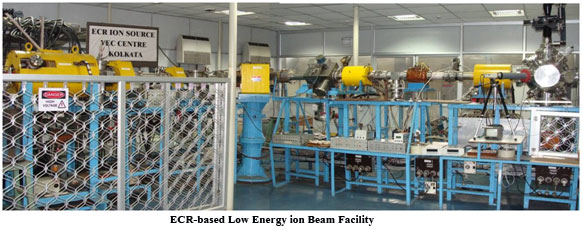
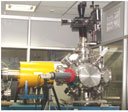
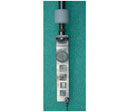
The ion beam is focused to a spot of about 2 mm diameter on the target using a set of glaser lenses. AX-Y scanner is used to scan the beam over a target area of 10mm x 10mm for uniform implantation. The sample chamber has provision for mounting multiple samples on indigenously developed disposable type beam viewer for in-situ beam viewing during implantation.
 |
 |
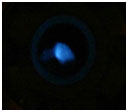 |
| Implantation chamber with sample manipulator | Beam spot on viewer | Target Ladder Assembly |
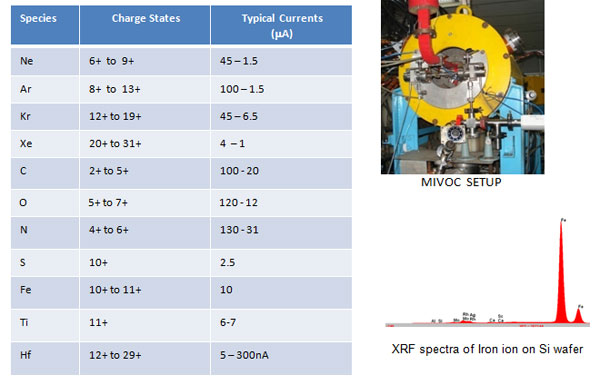
To meet the requirements of the material scienists, ion beams of S, Fe, Ti and Hf have also been developed using the MIVOC technique. In this method, the ion source feedmaterial usually is a high vapour pressure compound containing desired element. It has been observed that to obtain good yield the vapour pressure of the compound should lie between 10 to 0.1 Torr at room temperature. A dedicated set up has been developed for this purpose which has the pumping and vacuum measuring facility of its own. The MIVOC setup is electrically isolated from the ion source enabling its operation at ground potential. The vapour of the MIVOC compound is injected into the ion source using an electro-mechanically operated sapphire seal valve. With this arrangement it is possible to optimize the ECR parameters for the desired ion species. It has been observed that for certain ion species a suitable mixing gas is essential for improving the required beam yield.
14.45 GHz ECR ion source (ECR II) based heavy ion acceleration with K500 Superconducting Cyclotron at VECC:
Electron Cyclotron Resonance Ion Source (ECRIS) is an ion source that produces high current high charge state ion beams of almost all elements in the periodic table. Plasma is created in a chamber with the aid of microwave power. Permanent magnets and electromagnets are used to confine the plasma where the electrons gain energy by absorbing microwave power resonantly. Magnets are arranged in such a way that electrons are reflected from the edges of volume plasma towards the centre where the magnetic field is week. Electrons and ions have long life time in the plasma and hence undergo large number successive collisions and form high charge state ions. Several processes for ionization takes place in the plasma chamber at the same time. Out of many the electron – neutral, electron – ion, ion-neutral, ion-ion collisions are the major ionization processes that take place in the ion source. Microwave power, gas pressure and magnetic field profiles in the plasma chamber are the control knobs to change the charge state distribution in the ECR ion source.
Energy of the ions after acceleration in cyclotron is proportional to square of the charge state and hence higher the charge state of injected ion beam, higher is the energy gain by ions in the cyclotron.
An ECR (ECR-2) ion source operating at 14.45 GHz is installed to produce ion beams and inject into the cyclotron. Figure 1 presents a view of the ECR ion source where microwave injection system, water cooling lines etc can be seen.
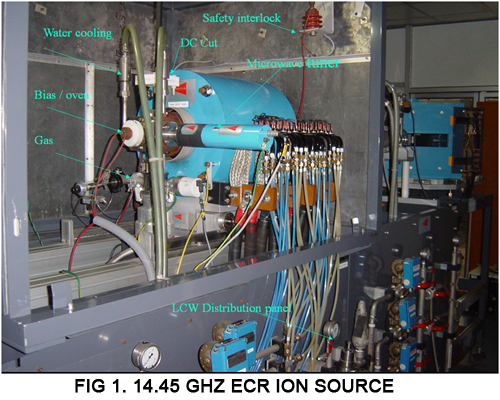
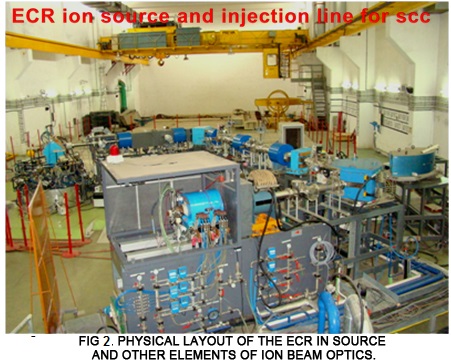
Figure 2 shows the physical layout as it exists on high-bay area. Ion beam extracted from ECR ion source is mass analyzed and bent twice to inject into the cyclotron. There are several optical elements such as Glazer lenses, bending magnets and steerers. There are a host of beam diagnostic elements such as Faraday cups and collimators distributed through-out the beam line. Three gridded ion beam buncher is installed in the vertical injection line to enhance the efficiency of injection and acceleration.
Control system of ECR ion source follows a distributed architecture to reduce enormous cabling and to improve the reliability. All parameters are controlled and monitored from one single computer placed in ion source hall of high-bay. In addition, all the parameters can also be controlled from another terminal in the main control room of superconducting cyclotron. Figure 3 shows the view of control room.
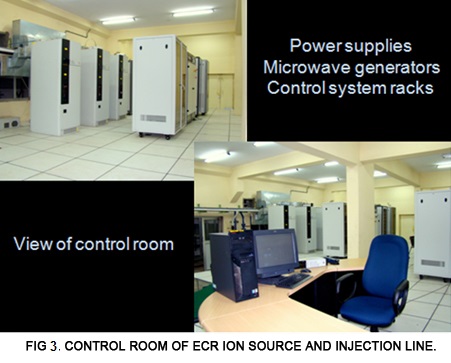
Figure 4 is the typical control panel of the ion source and injection line parameters. The page has tab controls and each tab is meant for control and monitor of particular group of parameters, e.g, first tab is for ion source control, second tab is for injection line control, third tab is for vacuum system control. The control system is developed in such a way that the ion beam from faraday cup and collimators can be observed on any page. This feature is very important because the ion beam position and profile down the beam line are affected by any optical elements placed upstream of the Faraday cup.
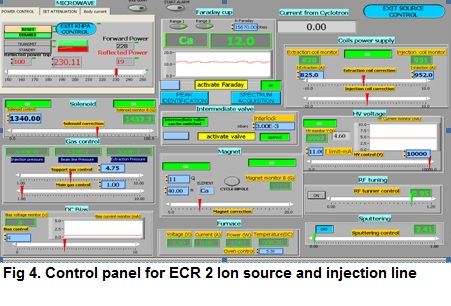
Control software also has a feature to continuously log the data and save the latest parameters for quick restart of the system in case of the power failures.
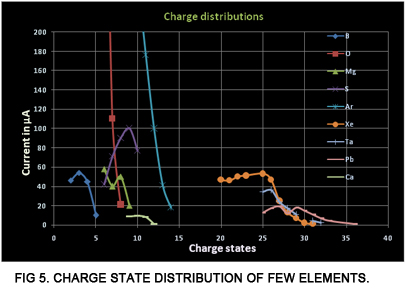
Sevearl ion beams have been developed and few of them are listed below in graphs shown in figure 5. Ion beams of solid elements are produced by using micro-oven and by sputtering method depending on the vapor pressures of different elements.
14.45 GHz ECR ion source (ECR III) based heavy ion acceleration with K130 Cyclotron at VECC:
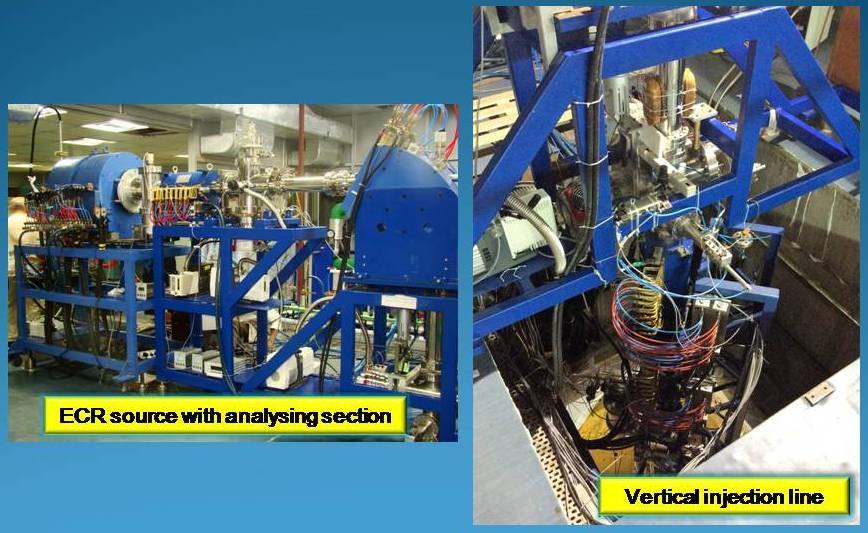
As a part of the heavy ion acceleration program with K130 room temperature cyclotron the 14.45 GHz. ECR source (ECRIII) produces multiply charged heavy ions and injects them into room temperature cyclotron for further acceleration.Figure 6 shows the ECR III source along with the injection beam line.
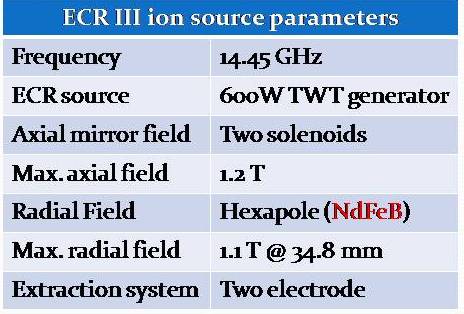
Following table shows the ECR source parameters.
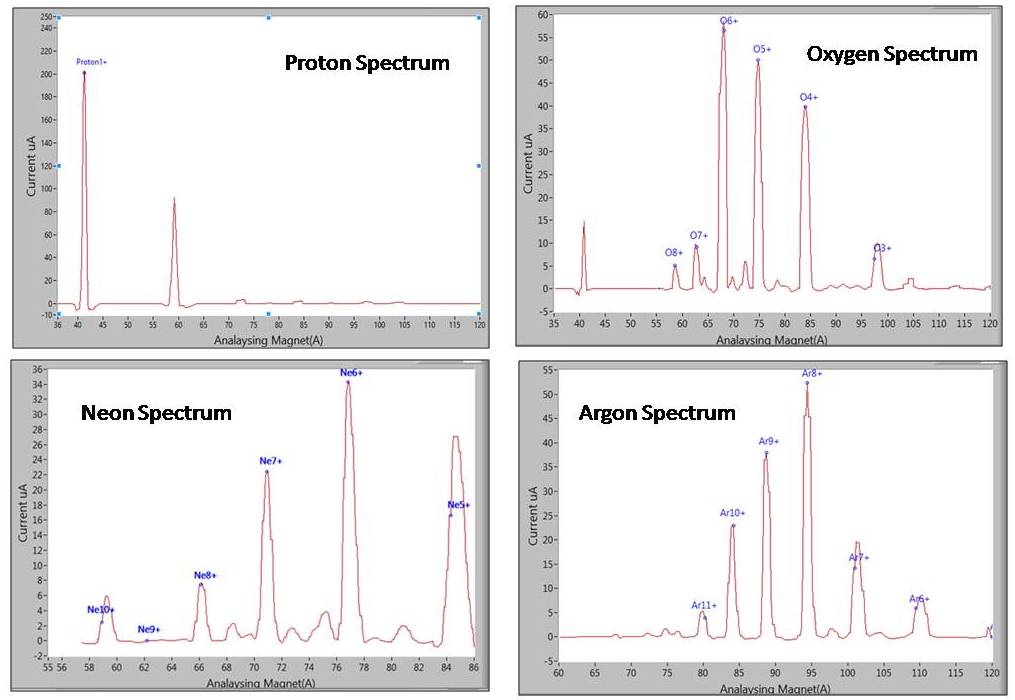
Following image shows the Spectrum of different samples as obtained from ECR 3.
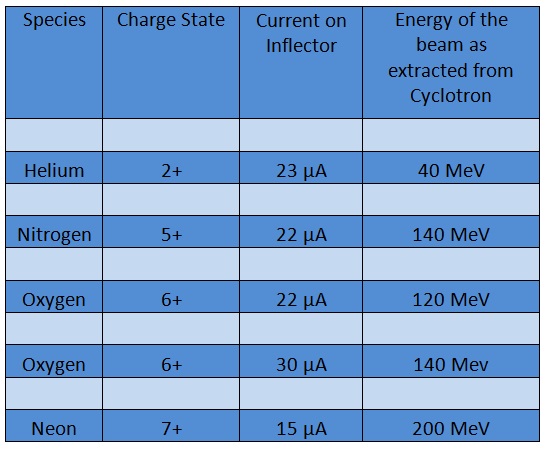
Typical beam currents as obtained from ECR 3 for acceleration in Room Temperature Cyclotron.
| Article | Author | Journal/Symposium | Year |
| A comprehensive study on the impact of He ion irradiation on the microstructure and mechanical properties of a Ni-Cr-Mo alloy | Sanjay Saini, Ranjini Menon, S. K. Sharma, P. Y. Nabhiraj, Suman Neogy & A. P. Srivastava | Scientific Reports (2025)15:28733 | 2025 |
| Surface modification of iron-zinc ions incorporated calcium phosphate biocomposite flexible films for biomedical applications | Jayapalan R R; Kumaravelu T A; Karthikeyan K R; Nabhiraj P Y ; Krishna J B M; Kaarthikeyan G; Sathiamurthi P; Gajendiran J ; Dong C L; Kalkura S N; | Materials Today Communications Vol 38 March 2024, 107988 | 2024 |
| Study on the effect of Ar9+ ion irradiation of Zr-2.5% Nb Alloy pressure tube | Aruna Devi, A P Srivastava, R. Menon, K V Manikrishna, S Neogy, G Kumar, P Y Nabhiraj, D Srivastava and G K Dey | Philosophical Magazine Part A: Materials science. Vol 99, (2019) Issue 4, 438-467 Oct 2018 | 2019 |
| Modeling and Optimization of the Effect of Sintering Parameters on the Hardness of Copper/GrapheneNanosheet Composites by Response Surface Methodology | N. Vijay Ponraj, A. Azhagurajan, S. C. Vettivel, X. Sahaya Shajan, P. Y. Nabhiraj, A. Haiterlenin | Metal Science and Heat Treatment 60, no 9-10, Jan (2019), 1-5 | 2019 |
| He and O ion implantation induced defects in Si crystal studied using slow positron annihilation spectroscopy | S.K.Sharma, K.Sudarshana, R.Menon, P.Y.Nabhiraj, P.K.Pujari | Nuclear Instruments and Methods in Physics Research B 453 (2019) 1–8 (May 2019) | 2019 |
| Observation of radiation enhanced phase formation and subsequent dissolution at very high doses in Ar9+ ion irradiated Ti-modified stainless steel | N Gayatri, Kalipada Das, P Mukherjee, Ranjini Menon, P Y Nabhiraj | Radiation Physics and Chemistry 165 (2019)108379 (24 June 2019) | 2019 |
| Core/shell structures on argon ions implanted polymer based zinc ionsincorporated HAp nanocomposite coatings | K R Karthikeyan, K Thanigai Arul, J Ramana Ramya, P Y Nabhiraj, R. Menon, J B M Krishna, S Narayan Kalkura. | Materials Science in Semiconductor Processing Volume 104, December 2019, 104687 | 2019 |
| Effect of Ar9+ Irradiation on Zr-1Nb-1Sn-0.1Fe alloy characterized by Grazing Incidence X-Ray Diffraction Technique | Argha Datta, Kalipada Das, Gayatri N B, Ranjini Menon, Nabhiraj P Y Paramita M | Radiation Physics and Chemistry 144 (2018) 125-131 (March 2018) | 2018 |
| Study of processing and microstructure of copper composite reinforced with grapheme nanosheet by powder metallurgy technique | N. Vijay Ponraj, A. Azhagurajan, S. C. Vettivel, X. Sahaya Shajan, P. Y. Nabhiraj | Powder metallurgy and metal ceramics 56 (2018) Issue (9-10) 523-534 (Feb 2018) | 2018 |
| Irradiation induced optical and electrical modification of Lexan films | Raveesha Pattaje, Nabhiraj Yalagoud, Ranjini Menon, Ganesh Sanjeev | Indian Journal of Pure & Applied Physics, Vol. 56, August 2018, pp. 591-594 | 2018 |
| 15. Graphene nanosheet as reinforcement agent in copper matrix composite by using powder metallurgy method | N. Vijay Ponraj a, A. Azhagurajan, S.C. Vettivel, X. Sahaya Shaj and, P.Y. Nabhiraj, M. Sivapragash | Surfaces and Interfaces 6 (2017) 190-196 | 2017 |
| Plasma treated titania aerogel nanostructures as photoanode material and itsinfluence on the performance of quasi-solid dye-sensitized solar cells | S Alwin, X Sahaya Shajan, Ranjini Menon, P. Y Nabhiraj, P V Ananthapadmanabhan. | Materials Research Bulletin 86 (2017) 201–208 | 2017 |
| Effects of low energy ions on the optical, structural and chemical properties of polycarbonate | Raveesha P M, Nabhiraj P Y, Ranjini Menon and Ganesh Sanjeeva. | AIP Conference Proceedings 1837, 040013 (2017) | 2017 |
| Influence of low-energy Argon ions on thermal and surface properties of polycarbonate films | P. M. Raveesha, P. Y. Nabhiraj,Ranjini Menon,S. D. Praveena and Ganesh Sanjeev | Radiation effects and Defects in Solids 172 (2017) 485-493 | 2017 |
| Effect of milling on dispersion of graphenenanosheet reinforcement in different morphology copper powder matrix | N. Vijay Ponraj, S.C. Vettivel, A. Azhagurajan, S. Sahaya shajan, P.Y. Nabhiraj, T. Theivasanthi, P. Selvakumarand A. Haiter Lenin | Surfaces and Interfaces 9 (2017) 260 - 265 | 2017 |
| An improved model to predict bandwidth enhancement in an inductively tuned common source amplifier | Ashif Reza, Anuraag Misra, Parnika Das | Review of Scientific Instruments 87(5):054710 2016 | 2016 |
| Ar irradiated Cr rich Ni alloy studied using positron annihilation spectroscopy | Sanjay Saini, Ranjini Menon, S.K. Sharma, A.P. Srivastava, S. Mukherjee, P.Y. Nabhiraj, P.K. Pujari, D. Srivastava, G.K. Dey | Journal of Nuclear Materials 479 (2016) 279-286 | 2016 |
| Surface stiffening and enhanced photoluminescence of ion implanted cellulose – polyvinyl alcohol and silica composite. | G.M. Shanthini, N. Sakthivel, Ranjini Menon, P.Y. Nabhiraj, J. A. Gómez-Tejedor, J.M. Meseguer-Dueñas, J.L. Gómez Ribelles, J.B.M. Krishna, S. Narayana Kalkura | Carbohydrate Polymer 153 (2016) 619-630 | 2016 |
| Ion implantation induced phase transformation and enhanced crystallinity of as deposited copper oxide thin films by pulsed laser deposition | Umesh Chandra Bind, Raj Kumar Dutta, Gurpreet Kaur Sekhon, KanhaiyaLal Yadav, J.B.M. Krishna, Ranjini Menon, P.Y. Nabhiraj | Superlattices and Microstructures 84 (2015) 24–35 | 2015 |
| Studies on space charge neutralization and emittance measurement of beam from microwave ion source | Anuraag Misra, Animesh Goswami, Paritosh Sing Babu, Saurabh Srivasatava, V.S.Pandit | Review of Scientific Instruments 86(11): 113301. 2015 | 2015 |
| High speed micro-fabrication using inductively coupled plasma ion source based focused ion beam system | Ranjini Menon and Nabhiraj P Y | Vacuum (2015) 111, 166-169 | 2015 |
| An integrated wire harp and readout electronics inside vacuum | Mou Chatterjee and P Y Nabhiraj | Review of Scientific Instruments 86, 034710 (2015) | 2015 |
| Depth-resolved slow positron beamanalysis of ECR proton and argon implanted graphite and boron nitride system | Bichitra Nandi Ganguly, Ranjini Menon, Nabhiraj P. Yalagoud, Sujit Kumar Bandyopadhyay, Wolfgang Anwandand Gerhard Brauer | Phys. Status Solidi B, 1–10 (2015) | 2015 |
| PAS Study of Zr-2.5%Nb Alloy Irradiated by Ar9+Heavy Ions | Aruna Devi, Ranjini Menon, Priya Maheshwari, S. Neogy, P. Y. Nabhiraj, P. K. Pujariand D. Srivastav | Journal of Physics: Conference Series618 (2015) 012018 | 2015 |
| Surface modification of titania aerogel films by oxygen plasma treatment for enhanced dye adsorption | S Alwin, X Sahaya Shajan, Ranjini Menon, P.Y Nabhiraj, K.G.K Warrier | Thin Solid Films 595 (2015) 164–170 | 2015 |
| Novel microporous surface and blue emission of argon ion implanted polyvinyl acohol/bionanohydroxyapatite coatings | K R Karthikeyan, K Thanigai Arul, J Ramana Ramya, P Y Nabhiraj, R. Menon, J B M Krishna, S Narayan Kalkura. | Radiation Physics and Chemistry Volume 171, June 2020, 108678 | 2020 |
| Synchrotron GIXRD and slow positron beam characterization o fAr ion irradiated pure V and V-4Cr-4Ti alloy: Candidate structural material for fusion reactor application. | Sudipta Mandal S. K. Sharma N. Gayathri K. Sudarshan P. Mukherjee P. K. Pujari Ranjini Menon P. Y. Nabhiraj Archna Sagdeode | Fusion Engineering and Design Volume 154, May 2020, 111518 | 2020 |
| Name | Contact Number | Member Details | |
| Neeraj | 033-23183287 | neeraj@vecc.gov.in | Details |
| Subhadip Biswas | 033-23183287 | s.biswas@vecc.gov.in | Details |
| Rajeev Kumar | 033-23183161 | rajeev.k@vecc.gov.in | Details |
| Arup Mahata | 033-23184237 | a.mahata@vecc.gov.in | Details |
| Dillip Kumar Behera | 033-23183287 | dkb@vecc.gov.in | Details |
| Dr. Anindita Bhowmick | 033-23184237 | bhowmick.anindita@vecc.gov.in | Details |
| S. Balabharathi | 033-23184238 | sbbharathi@vecc.gov.in | Details |
| Deepak Kumar Verma | 033-2318-3287/4560 | dk.verma@vecc.gov.in | Details |
| Kishore Rana | 033-23183287 | kishore@vecc.gov.in | Details |
| Prosenjit Majumdar | 033-23184560 | prosenjit@vecc.gov.in | Details |
| Dhananjoy Koley | 033-23184560 | dkoley@vecc.gov.in | Details |
| Rajkumar Prasad | 033-23184560 | rajkumar@vecc.gov.in | Details |
| L.C. Saren | 033-23183287 | lcsaren@vecc.gov.in | Details |
| Sumitra Majhi | 033-23183287 | sumitra_m@vecc.gov.in | Details |
| Suman Kumar Guha | 033-23184533 | suman@vecc.gov.in | Details |
| Dr. Ranjini Menon | 033-23183287 | ranjini@vecc.gov.in | Details |
| Mou Chatterjee | 033-23184560 | mou@vecc.gov.in | Details |
| Dr. Anuraag Misra | 033-23183216 | anuraag@vecc.gov.in | Details |
| Dr P. Y. Nabhiraj | 033-23183201 | npy@vecc.gov.in | Details |
| Manoj Kumar | 033-23183161 | mkumar@vecc.gov.in | Details |
| Tapan Kumar Mahalik | 033-23183161 | tkmahalik@vecc.gov.in | Details |
| Sushil Kumar Bera | 033-23183161 | sbera@vecc.gov.in | Details |
| Dilip Kumar Kar | 033-23183161 | dilipkumar@vecc.gov.in | Details |